


The Advantage of Human Resource Training for Drone Pilots & Visual Observers (VOs) in the Evolving Canadian Drone Landscape
By: Colonel (ret) Bernie Derbach, KR Droneworks Academy, 4 April 26
Inspired by: The work of Dr. Robert Baron regarding Human Factors (HF) in aircraft maintenance

The rapid professionalization of the Canadian drone industry marks a turning point where technical skill—while necessary—is no longer sufficient to guarantee safety or operational success. As Remotely Piloted Aircraft Systems (RPAS) integrate into complex environments like urban centers and shared industrial airspace, the "human element" has emerged as the primary variable in the safety equation.
Drawing inspiration from the work of Dr. Robert Baron regarding Human Factors (HF) in aircraft maintenance, this article examines how targeted Human Resource training provides a competitive and safety-oriented advantage for Canadian drone pilots and Visual Observers (VOs).
The Paradigm Shift: From "Hobbyist" to "Aviation Professional"
In the early years of the Canadian RPAS sector, training was largely focused on the "stick and rudder" skills—maneuvering the aircraft and understanding the basic physics of flight. However, as Transport Canada’s Part IX regulations evolve to include Beyond Visual Line of Sight (BVLOS) and "Level 1 Complex" operations, the industry is hitting a realization familiar to traditional aviation: systems don’t fail; people do.
Dr. Robert Baron, a leading expert in aviation safety, has long argued that Human Factors (HF) training in aircraft maintenance is often treated as a "check the box" exercise rather than a tool for behavioral change. For the Canadian drone landscape to mature safely, operators must move beyond the certificate and embrace HF as a core Human Resource (HR) strategy.
1. Moving Beyond "Check the Box" Training
The primary pitfall identified by Dr. Baron in maintenance sectors is the superficiality of safety training. In Canada, obtaining a Basic or Advanced Pilot Certificate involves answering questions on human factors (e.g., the "Dirty Dozen"), but this theoretical knowledge rarely survives the pressure of a real-world mission.
The HR Advantage: An organization that treats HF training as a continuous HR development goal—rather than a one-time licensing requirement—fosters a "Resilient Safety Culture." This means training pilots and VOs not just to know what fatigue is, but to have the assertiveness to ground a flight when they recognize it in themselves or their teammates.
2. The SHELL Model: Integrating the RPAS Crew
To understand the complexity of the drone pilot's role, we can look at the SHELL Model, a cornerstone of Human Factors training. It illustrates the relationships between different components of a system:
Software: Rules, regulations, and flight manuals.
Hardware: The drone, sensors, and Ground Control Station (GCS).
Environment: The harsh Canadian climate, urban congestion, and airspace.
Liveware: The human being (Pilot and VO) at the center.
In the Canadian drone landscape, "Liveware-Liveware" interactions (how the pilot interacts with the VO) are often the weakest link. High-level HR training focuses on optimizing these interfaces, ensuring that the human doesn't become the bottleneck for technology.
3. The Visual Observer (VO) as a Strategic Asset
In many operations, the VO is seen as a legal necessity rather than a strategic partner. However, in the complex Canadian airspace—where a drone might be sharing the sky with a medevac helicopter in rural Ontario or a floatplane in British Columbia—the VO is the primary safety net.
Communication Protocols: Effective HR training focuses on "Closed-Loop Communication." Instead of a VO saying, "Watch out for that bird," they are trained to say, "Bird, 2 o'clock, high, closing fast," and the pilot must acknowledge the specific instruction.
Hierarchical Flattening: Borrowing from Crew Resource Management (CRM), training must empower VOs to challenge a pilot's decision. If a pilot is fixated on the camera feed (automation bias) and misses a manned aircraft, the VO must feel psychologically safe to intervene immediately.
4. Addressing the "Disconnection Effect" and Automation Bias
A unique challenge for drone pilots, compared to the aircraft maintenance technicians Dr. Baron discusses, is the physical disconnection from the aircraft. A maintenance tech touches the engine; a drone pilot touches a plastic controller.
This "Disconnection Effect" can lead to a dangerous drop in risk perception. HR-driven training mitigates this by:
Virtual Presence Training: Teaching pilots to mentally project themselves into the cockpit to maintain situational awareness.
Automation Bias Awareness: Training crews to recognize when they are over-relying on GPS-hold or Return-to-Home (RTH) functions, which can lead to complacency and delayed reactions during a link loss.
5. Navigating the "Dirty Dozen" in Canada
Transport Canada references the "Dirty Dozen" (12 common precursors to human error). In the Canadian landscape, these take on specific, high-risk forms:
Factor | Canadian Drone Context |
Fatigue | Operating in -20°C weather or 14-hour summer daylight cycles in the North. |
Pressure | Tight windows for infrastructure inspections before a storm hits. |
Lack of Knowledge | Using new BVLOS technology without specific type-rating training. |
Distraction | Bystanders or "Kibitzers" approaching a pilot in a public park. |
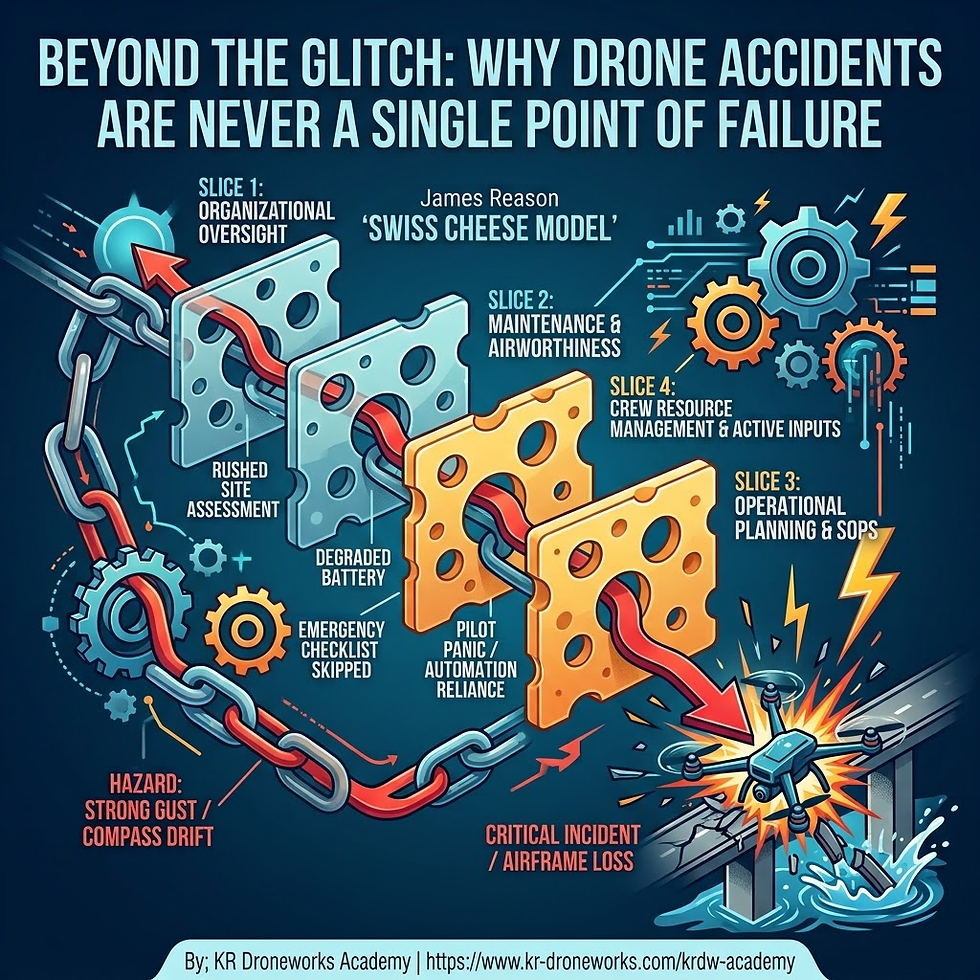
6. The Swiss Cheese Model of Accident Causation
When a drone crashes in a busy downtown core, it is rarely the result of a single error. According to the Swiss Cheese Model, accidents happen when "holes" (weaknesses) in various layers of defense align.
These layers include:
Organizational Influences: (e.g., Lack of HR funding for training).
Unsafe Supervision: (e.g., Dispatching a pilot into 40km/h winds).
Preconditions for Unsafe Acts: (e.g., Pilot fatigue or poor communication).
The Unsafe Act itself: (e.g., Failing to yield to a manned aircraft).
Robust HR training "plugs" these holes by creating redundancies in human behavior.
Shutter-stock

7. Management Buy-In: The ROI of Safety
Dr. Baron emphasizes that the biggest hurdle to effective HF training is often "Upper Management." If leadership views training as an expense to be minimized, the safety culture will be fragile.
The Business Case for Canadian Operators:
Reduced Hull Loss: High-quality training prevents the "procedural deviations" that lead to expensive equipment crashes.
Insurance Benefits: Many Canadian insurers are beginning to look favorably upon organizations that implement formal Safety Management Systems (SMS).
Regulatory Compliance: As Transport Canada moves toward more complex SFOC (Special Flight Operations Certificate) requirements, having a documented HR training program becomes a prerequisite for advanced permissions.
Conclusion: Engineering a Safer Future
The Canadian drone industry is no longer in its infancy. It is a vital part of our national infrastructure, from monitoring pipelines to delivering medical supplies. To lead globally, we must recognize that the most sophisticated AI and sensors are still managed by human beings prone to stress, fatigue, and error.
By adopting Dr. Robert Baron’s philosophy—that HF training must be relevant, practical, and supported by management—Canadian operators can transform their pilots and VOs from "technicians" into "aviation professionals." The advantage is clear: those who invest in the human element will fly longer, safer, and more profitably than those who simply check the box.
References & Further Reading
Baron, R. (2024). Benefits of Human Factors Training in Aircraft Maintenance. LinkedIn Article.
Transport Canada. TP 12863 - Human Factors for Aviation: Basic Handbook. Government of Canada Portal.
Transport Canada. TP 15263 - Knowledge Requirements for Pilots of RPAS. Standard for Basic and Advanced Operations.
Skybrary. The Dirty Dozen. Aviation Safety Knowledge Base.
Kr Droneworks. Elevate Your Drone Operations: A Blueprint for Canadian RPAS Human Factors. Industry Perspective.

Comments