


The Complacency Trap — Why Your Drone’s Safety Assurance Isn't 'Set and Forget
By: Colonel (ret) Bernie Derbach, KR Droneworks Academy, 09 July 26
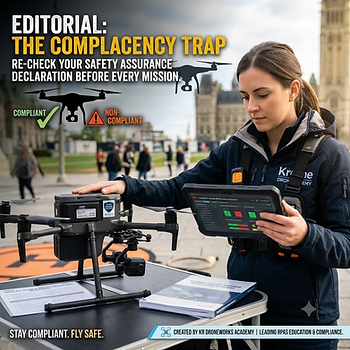
In the early days of advanced drone operations in Canada, compliance felt like a checklist you completed once. You chose a drone, verified its manufacturer declaration, registered it with Transport Canada (TC), and took to the skies.
But as the regulatory landscape matures—underscored by the implementation of Standard 922 and modernized RPAS Safety Assurance requirements—treating compliance as a historical event rather than a pre-flight routine is a recipe for serious regulatory trouble.
As remote pilots, we are fundamentally managers of risk. Yet, a subtle complacency has crept into our pre-flight workflows regarding the legal operational envelope of our aircraft. The hard truth is this: just because your drone was legally approved for a specific mission last month does not mean it is legally approved for that same mission today.
Standard 922 strictly defines the technical thresholds for advanced and Level 1 Complex operations, dictating exactly what a drone can do regarding controlled airspace, operations near people, and flights over people. It also introduces rigid metrics for command-and-control links, containment, and environmental envelopes. Under this framework, Transport Canada relies on manufacturer self-declarations (Safety Assurance Declarations, or SADs).
Here is the catch that many operators overlook: declarations are dynamic, not permanent.
Transport Canada explicitly states that a drone's safety assurance can be invalidated after it has been listed. If a manufacturer fails to uphold a standard, or if a newly discovered software or hardware vulnerability compromises a Standard 922 metric (like containment or link reliability), TC will invalidate that specific declaration. While Transport Canada does issue email notifications and updated registration certificates when a registered RPAS loses its status, relying solely on your inbox is a dangerous gamble. Software filters misplace emails, registrations change hands, and corporate communication gaps happen.
Furthermore, meeting the safety assurance for one type of advanced operation does not magically grant a blank check for all of them. A drone declared safe to fly within 30 meters of bystanders (Standard 922.05) is legally grounded the moment you command it to cross over those bystanders unless it holds an explicit declaration for Standard 922.06.
If you are planning a mission that pushes into advanced or complex territory—whether it is a routine inspection in controlled airspace or a complex flight over an urban center—checking the TC RPAS Safety Assurance list must become as reflexive as checking the weather.
Before every deployment, make it a standard operating procedure to log on and cross-reference your specific aircraft model against the live TC registry. Ensure that the manufacturer's declaration explicitly covers the exact operational parameters—near people, over people, or controlled airspace—demanded by your upcoming flight.
The aviation world has always penalized assumptions. In the RPAS sector, assuming your drone still holds the clearance it had at the time of purchase is an unnecessary risk. Take five minutes before your next mission to verify your safety assurance declaration. Protect your flight record, protect your business, and keep Canadian skies safe.
References
Transport Canada: Choosing the right drone for advanced and complex operations
Transport Canada: Standard 922 – RPAS Safety Assurance
Transport Canada: Drone Management Portal (Log in to verify individual aircraft registration status and active manufacturer safety declarations).

Comments