


A Comprehensive Guide to Launching an Autonomous Drone Business with the DJI Matrice 4TD & DJI Dock 3
By: Colonel (ret) Bernie Derbach, KR Droneworks Academy, 26 July 26
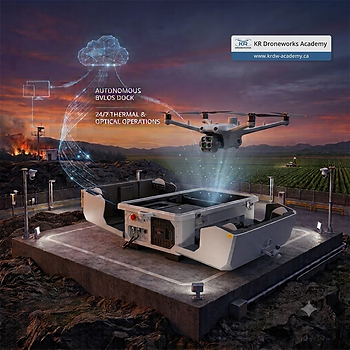
The commercial Remote Piloted Aircraft System (RPAS) industry is undergoing a generational shift. For over a decade, drone service providers relied on human pilots standing in field environments, swapping batteries, and holding controllers. Today, enterprise aerial operations have shifted toward autonomous, remote-operated, Beyond Visual Line of Sight (BVLOS) drone docks (often referred to as "Drone-in-a-Box" systems).
At the forefront of this shift is the flagship enterprise combination from DJI: the DJI Matrice 4TD aircraft and the DJI Dock 3 autonomous base station.
This article serves as an all-inclusive playbook for entrepreneurs, enterprise innovation leads, and drone service providers looking to build or scale a business around autonomous aerial operations. It covers technical hardware specs, multi-industry applications, operational advantages over legacy methods, regulatory compliance under Transport Canada, a complete financial model in Canadian Dollars (CAD), and a step-by-step launch roadmap.
Executive Summary: The Business Opportunity
Historically, commercial drone operations were throttled by labor costs: every flight required a certified pilot and an observer physically on site.
The DJI Matrice 4TD and Dock 3 pairing transforms aerial operations from an event-driven, labor-heavy service into an automated, software-driven background utility.
Once deployed on a client site or mounted to a mobile response vehicle, the dock handles launching, landing, rapid charging, and data offloading automatically via the cloud.
Key Value Drivers for Service Providers
High-Margin Recurring Revenue: Shift from low-margin single flight gigs to high-margin monthly software and surveillance retainers ($3,000–$8,000 CAD/month per dock).
24/7 Deployment Capability: Execute scheduled or event-triggered missions around the clock, in pitch darkness, extreme cold (-30°C), or heavy rain.
Remote Operational Radius: Control units deployed hundreds of kilometers away directly from an office or dispatch center via DJI FlightHub 2.
Hardware Architecture: Technical Deep-Dive
Understanding the hardware engineering is critical when pitching technical enterprise clients or applying for regulatory BVLOS waivers.
System Components & Ecosystem Integration
DJI FlightHub 2 (Cloud Operations Hub): Serves as the centralized web-based control tower. Operators create 3D flight routes, monitor real-time encrypted video feeds, schedule recurring maintenance runs, and process thermal mapping data automatically without visiting the physical deployment site.
DJI Dock 3 (Base Station): The weather-sealed, autonomous station installed on-site. It manages battery maintenance, climate conditioning, and local satellite positioning (RTK) while physically protecting the aircraft between missions.
DJI Matrice 4TD (Enterprise Thermal Aircraft): The airborne sensor unit designed for all-weather thermal, optical, and laser range-finding missions, equipped with O4+ transmission links back to the dock.
1. DJI Matrice 4TD Aircraft
The Matrice 4TD is engineered specifically for remote industrial inspection, public safety, and night operations. It consolidates a multi-sensor payload into a compact, IP55 weather-rated airframe:
Radiometric Thermal Sensor: Native 640×512 resolution (expandable to 1280×1024 UHR Mode) with a temperature measurement range from -20°C to 550°C. Supports spot temperature checks and area thermal alerts.
Triple Optical Camera Array:
Wide-Angle: 48MP, 1/1.3" CMOS sensor (24mm equivalent) for broad area situational awareness.
Medium Tele: 48MP, 1/1.3" CMOS sensor (70mm equivalent) for mid-range structural inspection.
Telephoto: 48MP, 1/1.5" CMOS sensor (168mm equivalent) delivering crisp detail up to 250 meters away.
Integrated Laser Rangefinder (LRF): Measures distance and calculates precise GPS coordinates of targets up to 1,800 meters away.
Night Operations Suite: Features a Near-Infrared (NIR) auxiliary light (up to 100m illumination range) and an IR-Cut filter to switch between color night vision and enhanced infrared thermal imaging in total darkness.
Flight Performance: Maximum flight time between 47 (hovering) to 54 minutes (forward flight), up to 21 m/s speed, and an operational flight radius up to 10 km from the dock under O4+ transmission.
2. DJI Dock 3 Base Station
The Dock 3 acts as the autonomous home base, weather station, and rapid charging hub:
All-Weather Durability: Rated IP56 for dust and water ingress, operating in ambient temperatures from -30°C to 50°C. Built-in internal climate control (compressor-based air conditioning and heating) ensures aircraft battery protection in freeze or heatwave conditions.
Rapid Charging: Replenishes the Matrice 4TD battery from 15% to 95% in approximately 27 minutes.
Integrated RTK & Environmental Sensors: Features dual RTK positioning antennas (achieving centimeter-level landing accuracy) alongside integrated sensors for wind speed, rainfall, ambient temperature, water immersion, and humidity.
Mobile Vehicle Mounting: Engineered to support both fixed ground installations and vehicle-mounted mobile deployments (e.g., mounted to pickup truck beds or emergency command trailers).
Connectivity & Backup: Supports Gigabit Ethernet and 4G Cellular backup via DJI Cellular Dongle 2, with an internal lead-acid backup battery providing over 4 hours of standby power during main grid power outages.
Industry Applications: Detailed Operational Workflows
To build a lucrative business, you must package the hardware into specialized industry solutions. Here is how the system operates across key enterprise verticals.
1. Ground Search and Rescue (GSAR) & First Response
The Problem: Traditional search operations rely on slow ground teams bushwhacking through dense terrain or high-cost manned helicopters.
The Workflow:
A 911 dispatch integration triggers an automatic launch request via DJI FlightHub 2.
The Dock 3 opens and dispatches the Matrice 4TD within 45 seconds.
The drone flies autonomously to the last known GPS coordinate.
Using the radiometric thermal camera and NIR night light, the drone scans the canopy for body heat signatures.
Once a heat signature is located, the operator uses the 1,800m Laser Rangefinder to pin exact coordinates directly onto the emergency team's mobile mapping software.
2. Wildfire Hotspot Detection & Forestry Management
The Problem: Holdover fires and smoldering underground root systems can reignite hours or days after a wildfire appears contained.
The Workflow:
Docks stationed along forestry perimeter zones execute automated morning and evening thermal sweep routes.
The Matrice 4TD flies pre-planned grid lines, capturing high-resolution radiometric thermal imagery.
Cloud software automatically flags surface temperature anomalies exceeding baseline limits (e.g., ground spots over 60°C).
Forestry officials receive an instant alert containing the exact GPS location, visual photo, and thermal layer map before smoke is visible to the naked eye.
3. Precision Agriculture & Irrigation Management
The Problem: Crop stress, irrigation leaks, and soil compaction often go unnoticed until crop yield is permanently damaged.
The Workflow:
The drone executes scheduled daily flights over large agricultural acreage.
Thermal sensors detect subtle plant transpiration changes—crops suffering from water stress appear warmer than hydrated crops due to reduced evaporative cooling.
Photogrammetry data captured by the 48MP wide-angle camera generates ortho-mosaic maps to pinpoint irrigation line breaks or pump failures.
4. High-Voltage Utilities, Solar & Infrastructure Inspection
The Problem: Manual inspection of solar farms or utility substations requires hours of walking with hand-held thermal cameras or taking dangerous high-voltage line outages.
The Workflow:
The Matrice 4TD executes automated 3D waypoint missions around substations and solar arrays.
Solar Farms: Radiometric thermal imaging immediately identifies malfunctioning photovoltaic cells, bypass diode failures, or hot spots causing energy drops.
Power Lines: Upward gimbal tilt capability (+80°) allows inspection of insulator caps and transformer bushings from underneath without risking pilot line contact.
5. 24/7 Security, Mining & Industrial Perimeter Monitoring
The Problem: Fixed CCTV cameras have blind spots, and security guards on foot patrols cannot cover vast industrial yards, ports, or mine sites quickly.
The Workflow:
Fixed Dock 3 units conduct continuous, rotating 24/7 perimeter patrols around the facility.
When fence sensors or laser tripwires detect a perimeter breach, the dock automatically dispatches the Matrice 4TD to the breach point.
FlightHub 2 streams live encrypted optical and thermal video directly to off-site security command centers, while AI change detection identifies moved assets or unauthorized vehicles.
Competitive Advantage: Manned vs. Manual vs. Dock 3 System
When pitching clients, use this direct side-by-side ROI comparison:
Metric / Capability | Manned Aircraft / Helicopter | Manual Ground Pilot + Drone | DJI Matrice 4TD + Dock 3 |
Operating Cost per Hour | $1,800 – $3,500 CAD / hr | $150 – $300 CAD / hr (Labor heavy) | <$20 CAD / flight (Amortized CapEx) |
Response Time | 30 to 60+ minutes | 45 to 90 minutes (Transit time) | Under 45 seconds to air |
Operational Continuity | Short sorties; fuel constrained | Battery-swap limited; pilot fatigue | 24/7 continuous operation via 27-min fast charging |
All-Weather Capability | Good, but pilot safety dependent | Poor (Vulnerable to cold/rain) | IP56 Dock / IP55 Drone (-30°C to +50°C) |
Data Consistency | Low (Handheld photos vary) | Medium (Pilot flight variances) | High (Centimeter-level repeatable RTK paths) |
Canadian Regulatory Framework: Transport Canada & BVLOS Compliance
To operate an autonomous drone dock in Canada, your business must comply with Canadian Aviation Regulations (CARs) governed by Transport Canada (TC).
1. Pilot Certification Requirements
Advanced RPAS Certificate: The baseline requirement for flying in controlled airspace or near people (passing TC Advanced Exam and Flight Review).
Level 1 Complex Operations (L1C / BVLOS): To operate a dock remotely without visual line of sight, pilots must complete an approved Level 1 Complex / BVLOS training course covering remote command station ops, air traffic risk, and fail-safe automation.
2. Special Flight Operations Certificate (SFOC-RPAS)
For unattended or remote dock operations, operators must submit an SFOC application to Transport Canada containing:
ConOps (Concept of Operations): Detailing physical dock security, emergency response plans (ERP), site risk assessments, and weather limitations.
SORA (Specific Operations Risk Assessment): Demonstrating how ground risk (population density) and air risk (controlled airspace, low-altitude traffic) are mitigated.
Fail-Safe Measures: Utilizing integrated terrain awareness, automated Return-to-Home (RTH), geo-fencing, obstacle sensing, and real-time airspace monitoring (ADS-B receiver).
Comprehensive Financial Model & Startup Cost (CAD)
Below is a realistic, itemized financial model for launching a turnkey single-dock drone service business in Canada.
1. Capital Expenditure (CapEx) – Equipment & Setup
Item Description | Estimated Cost (CAD) |
DJI Dock 3 Station Enclosure | $21,500 |
DJI Matrice 4TD Aircraft Platform | $9,000 |
Ground Concrete Pad / Steel Mounting Structure | $1,500 |
Hardwired AC Power Hookup & Surge Suppression | $1,200 |
Cellular 4G Dongle 2 & External Antennas | $600 |
On-Site Security Enclosure / Anchor System | $800 |
Subtotal CapEx | ~$34,600 CAD |
2. Operational Expenditure (OpEx) – Annual Recurring
Item Description | Estimated Annual Cost (CAD) |
DJI FlightHub 2 Professional License | $1,800 |
Enterprise 4G/LTE High-Data SIM Card Plan | $900 |
DJI Care Enterprise Plus Comprehensive Protection | $2,500 |
Aviation Commercial Liability Insurance ($5M Coverage) | $3,500 |
Scheduled Spare Parts / Battery Replacement Fund | $1,500 |
Subtotal OpEx (Annual) | ~$10,200 CAD/year |
3. Training, Regulatory & Licensing Costs
Item Description | Estimated Cost (CAD) |
Advanced RPAS Ground School & Flight Review | $1,000 |
Level 1 Complex / BVLOS Pilot Training Course | $2,000 |
Transport Canada Exam Fees & Registration | $150 |
SFOC Application / Regulatory Consultant Fee | $2,500 |
Subtotal Licensing & Training | ~$5,650 CAD |
Financial Summary & Initial Capital Required
Total All-In Initial Investment: ~$50,450 CAD
Target Monthly Service Retainer (Per Dock): $4,500 – $7,500 CAD / month
Estimated Gross Annual Revenue (1 Dock): $54,000 – $90,000 CAD
Projected Break-Even Timeline: 8 to 12 Months
Step-by-Step Business Launch Roadmap
If you are starting from ground zero, follow this chronological execution roadmap:
Phase 1: Pilot & Organizational Licensing
Complete Advanced RPAS certification and enroll key operators in Level 1 Complex (BVLOS) ground school.
Incorporate your business entity and secure $2M–$5M in Aviation Commercial General Liability Insurance.
Phase 2: Hardware Acquisition & Testing
Partner with an authorized Canadian DJI Enterprise dealer to procure the Dock 3 and Matrice 4TD.
Set up a bench-testing site in non-controlled airspace to master DJI FlightHub 2 route planning, cloud data streaming, and automated flight triggers.
Phase 3: Secure Client Pilot Site & Apply for SFOC
Identify an anchor client (e.g., mine site, solar farm, or security facility) willing to host a pilot dock deployment.
Conduct a formal site hazard assessment and submit your SFOC application to Transport Canada for BVLOS authorization.
Phase 4: Installation & Site Commissioning
Install concrete pad or vehicle mount, connect main power supply, configure 4G LTE network redundancy, and calibrate the internal RTK base station.
Phase 5: Transition to Recurring Retainer Contracts
Shift client contracts to automated monthly retainers covering site surveillance, scheduled thermal asset reports, and priority emergency dispatch.
Direct Reference Directory
DJI Enterprise Official Site: DJI Enterprise Official Platform
Canadian Enterprise Equipment Distributors: DrDrone Canada Matrice 4TD Page | DronePoint Canada Specs
Transport Canada Drone Safety & BVLOS Standards: Transport Canada RPAS Management & Regulations
Canadian BVLOS Training Academies: Coastal Drone Training Programs | Drone Académie Professional Bundles


Comments