


Beyond the Glitch: Why Drone Accidents Are Never a Single Point of Failure
By: Colonel (ret) Bernie Derbach, KR Droneworks Academy, 29 Sep 26
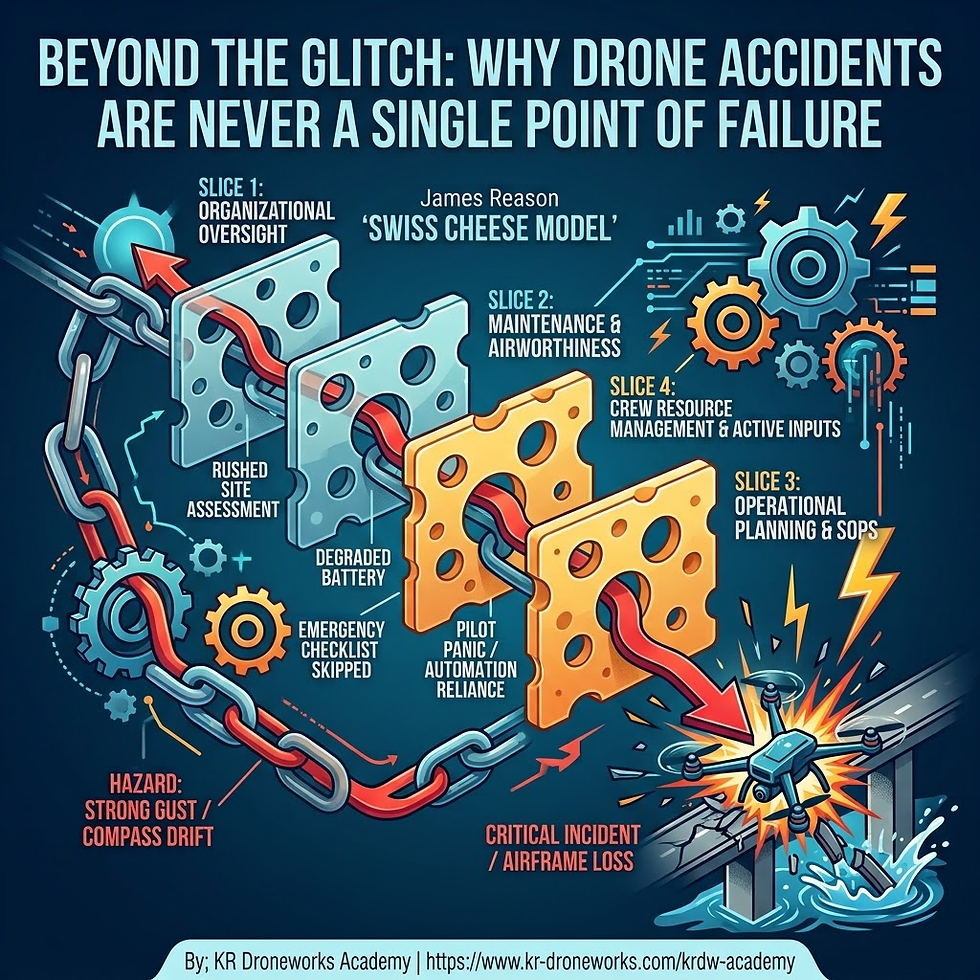
When a commercial drone drops from the sky, collides with infrastructure, or drifts away uncontrolled, the post-incident postmortem often gravitates toward an easy, convenient culprit: the compass suffered magnetic interference, the battery failed, or pilot error caused the crash.
Attributing a Remotely Piloted Aircraft System (RPAS) incident to a solitary technical glitch or a split-second operator misstep fundamentally misinterprets aviation safety.
In professional aviation and advanced RPAS operations, catastrophic outcomes are virtually never the result of a single point of failure. Instead, they represent the final snap in an interconnected chain of events—a breakdown where multiple systemic, organizational, environmental, and procedural safeguards fail simultaneously.
Understanding why drone incidents occur requires examining how these modern aerial platforms interact with human decision-making, operational environments, and organizational pressure.
The Anatomy of an Error Chain: Reason’s Swiss Cheese Model
Aviation safety pioneer James Reason introduced the Swiss Cheese Model of Accident Causation to explain complex system failures. In this framework, an organization's defenses against catastrophe are represented as multiple slices of cheese stacked back-to-back:
Organizational and Regulatory Oversight: High-level policies, internal safety culture, operational budgets, and resource allocation.
Maintenance and Airworthiness: Regular inspections, firmware validation, propeller structural checks, and battery cycle tracking.
Operational Planning and Standard Operating Procedures (SOPs): On-site surveys, airspace authorizations, weather evaluations, and formal risk assessments.
Crew Resource Management and Active Inputs: Pilot-in-command stick inputs, automated telemetry monitoring, and Visual Observer callouts.
Each slice represents a safeguard designed to stop a hazard from turning into an accident. Every slice also has flaws—the "holes" in the cheese. These holes are constantly shifting, opening, and closing based on real-time operational factors.
A single hole—such as a GPS multipath glitch next to a concrete structure—rarely causes a crash on its own. The pilot can switch to manual altitude hold, the surrounding airspace is clear, or fail-safe geofencing keeps the craft contained. An accident occurs only when the holes in every single protective barrier align momentarily, giving an active hazard an uninterrupted trajectory directly to disaster.
Latent Conditions vs. Active Failures
To uncover why modern RPAS fail, accident investigators divide contributing factors into two categories: latent conditions and active failures.
Latent Conditions (The Hidden Traps)
Latent conditions are decisions made days, weeks, or months before the flight by management, software engineers, or maintenance teams. They lie dormant within the system until triggered:
Schedule Pressure: Rushing field teams to complete back-to-back utility inspections before dusk, tacitly discouraging thorough pre-flight checklists.
Incomplete SOP Suites: Operating complex flights without standardized, tested emergency response procedures or abort criteria.
Documentation Gaps: Failing to track battery cycle logs or propeller lifespan hours across shared fleet equipment.
Automation Complacency: Relying blindly on automated return-to-home algorithms without training crews on manual failsafes.
Active Failures (The Trigger at the Controls)
Active failures are the unsafe acts committed by people directly in contact with the equipment, such as the pilot-in-command, payload operator, or visual observer. These include misjudging distance to a structure, flicking the wrong flight-mode toggle, or ignoring a low-voltage chime.
Crucially, the active failure is usually just the match that lights a fuse manufactured by latent conditions. Blaming the pilot for a late-afternoon collision ignores the institutional choices that left them exhausted, under-equipped, and working with an unverified firmware release.
Deconstructing the Chain: The "Sudden Flyaway" Scenario
Consider a typical industrial incident narrative: during an automated bridge pier mapping mission, a drone suddenly drifted sideways, struck a support girder, and plummeted into the water. Equipment malfunction was suspected.
When investigators pull the telemetry, black-box flight logs, and maintenance records, the single point of failure evaporates into an interrelated sequence across five operational layers:
Mission Planning and Environmental Analysis: The mission planner scheduled the flight in close proximity to heavily reinforced concrete without accounting for degraded satellite geometry, compromising positional tracking before the drone ever left the ground.
Standard Operating Procedures (Pre-Flight): Facing client delays, the flight crew hurried through site setup, skipping both the manual compass calibration check and failsafe verification procedures.
Hardware and Fail-Safe Configuration: The Return-to-Home altitude remained set at the factory default of 30 meters—a height lower than the bridge deck's structural steel girders.
Sensor Fusion and Environmental Dynamics: Rebar proximity triggered magnetic interference, causing severe compass drift. The flight controller rejected the corrupted GNSS data and automatically downgraded into manual attitude mode, disabling automatic hover hold.
Crew Proficiency and Automation Reliance: Having trained primarily on GPS-assisted modes, the pilot was unaccustomed to manual attitude recovery, suffered cognitive overload, and entered incorrect counter-steering inputs, resulting in the collision.
Had any single one of these five safeguards functioned as intended—whether through proper planning, thorough pre-flight checklists, correct return altitude settings, or manual recovery training—the catastrophic loss would have been prevented.
Why RPAS Are Uniquely Vulnerable to Chain Failures
RPAS operate across a precarious intersection of consumer electronics, cutting-edge software algorithms, dynamic micro-weather, and regulated airspace. This environment introduces specific failure points rarely seen in traditional crewed aviation:
Sensory Detachment: Unlike a pilot inside a cockpit who feels airframe vibrations and yaw forces directly through physical movement, an RPAS pilot relies strictly on telemetry readouts and ground perspectives. Subconscious physical cues of an impending stall or motor drag are absent.
The Black-Box Nature of Autonomous Logic: Flight controllers continuously synthesize data from barometers, magnetometers, inertial measurement units, optical flow sensors, and satellite constellations. When anomalous readings cause sensor fusion discrepancies, automated routines (like automatic landing or aggressive altitude correction) can kick in abruptly without the pilot fully grasping the internal machine state.
The "Toy" Mindset vs. Operational Discipline: Because modern enterprise drones are remarkably stable straight out of the box, organizations often assume that flying safely is straightforward. They overlook the aviation-grade disciplines—Safety Management Systems, clear Standard Operating Procedures, fatigue management, and regular recurrent training—that keep operations resilient when hardware degrades.
Breaking the Chain: Designing High-Reliability Operations
Building an operation that avoids catastrophic losses means designing workflows that make single failures inconsequential.
Treat Every Near-Miss as a Broken-Chain Indicator
A close call is not evidence that your crew is lucky; it is evidence that one of your redundant layers held while three others silently failed. A non-punitive internal reporting system encourages pilots to flag battery voltage drops, anomalous controller disconnections, or missed visual checkpoints without fear of reprisal.
Codify Operational Rigor Through Documented SOPs
Checklists and Standard Operating Procedures exist to prevent active human slips during routine flights. From verifying obstacle clearance envelopes to confirming geofence limits and fail-safe return behaviors, systematic procedures prevent basic oversights from ever reaching the flight line.
Train for Degradation, Not Perfection
Flight competency is not demonstrated when the skies are clear and the flight computer handles all the stabilization. True airmanship is forged in degraded states:
Practicing hand flying with satellite positioning and obstacle avoidance turned off.
Drilling lost-link and control-station power failure procedures until responses are muscle memory.
Establishing firm "no-go" abort criteria based on gust thresholds, visibility minimums, and crew duty limits.
Catastrophic drone incidents do not originate at the moment of impact. They begin in the conference room during project scheduling, in the shop during casual maintenance, and in the field when a tired crew decides a step on the checklist is unnecessary. Recognizing that safety is a woven web of interdependent defenses transforms an operation from fragile to resilient.
References & Further Reading
Reason, J. (1990). The Contribution of Latent Human Failures to the Breakdown of Complex Systems. Philosophical Transactions of the Royal Society of London. Read more on the SKYbrary James Reason Swiss Cheese Model Overview.
Federal Aviation Administration (FAA). Introduction to Safety Management Systems (SMS) for Operations. Learn more at the FAA Safety Management System Resource Page.
International Civil Aviation Organization (ICAO). Remotely Piloted Aircraft Systems (RPAS) Manual (Doc 10019). Access guidance via the ICAO RPAS Portal.
UK Air Accidents Investigation Branch (AAIB). Unmanned Aircraft System (UAS) Investigation Reports & Bulletins. View reports on the AAIB UAS Investigation Index.


Comments