


Unlocking BVLOS: What "Shielded" Operations Mean for Drone Safety in Canada and Beyond
By: Colonel (ret) Bernie Derbach, KR Droneworks Academy, 04 Oct 26
(credit to: Peter Frank Linkedin article: https://www.linkedin.com/feed/update/urn:li:activity:7511833442922364928/
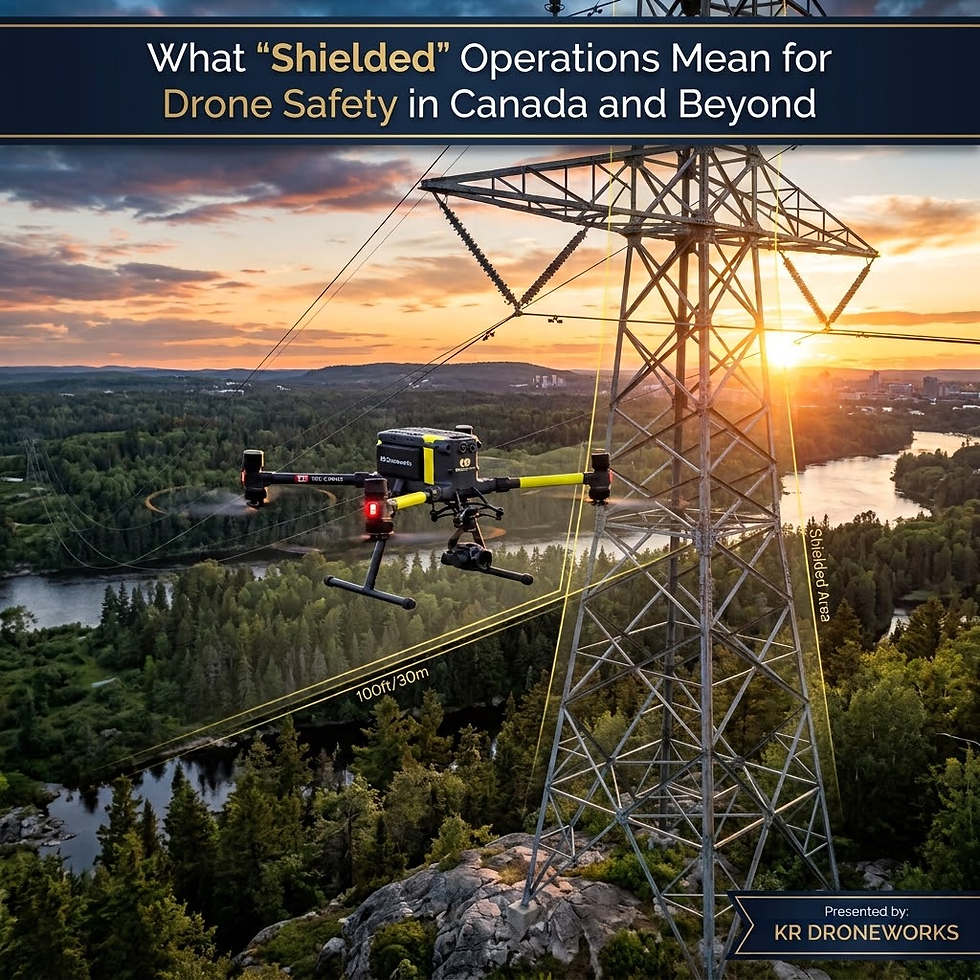
Integrating Beyond Visual Line of Sight (BVLOS) flights into civil airspace often focuses heavily on high-cost technological interventions: active onboard radar, cooperative transponders, optical camera arrays, and complex acoustic Detect-and-Avoid (DAA) avionics.
Yet one of the most effective, mathematically robust air-risk mitigations requires no electronics at all: shielded operations.
Using physical structures as an operational barrier fundamentally rethinks risk management. When evaluated through Transport Canada’s evolving regulatory framework under the Canadian Aviation Regulations (CARs) Part IX and the JARUS Specific Operations Risk Assessment (SORA) model, operational shielding emerges as an indispensable foundation for low-altitude RPAS integration.
What Does "Shielded" Actually Mean?
At its core, shielding is an intuitive risk-mitigation concept: an un-crewed aircraft system (UAS) operates close enough to a physical obstacle or structure that the obstacle itself creates a physical sanctuary from crewed air traffic.
Crewed aircraft—whether a Cessna 172 on a cross-country route, an air ambulance helicopter, or a floatplane landing on a lake—are legally and practically prohibited from skimming inches away from transmission towers, hugging the steel underbelly of a suspension bridge, or clipping along the side of a skyscraper. Regulations around minimum obstacle clearance altitudes exist to prevent controlled flight into terrain or obstacles.
By constraining a drone's flight path within that exact obstacle boundary, the physical environment provides passive air risk mitigation. The risk of mid-air collision with a crewed aircraft drops significantly without requiring a heavy, power-hungry DAA sensor payload onboard the drone.
Across industry discussions and standards bodies, this is variously termed:
Shielded Operations
Shielded Volumes / Areas
Sheltered Operations
Shielded Corridors
Transport Canada’s Perspective: Sheltered Flight Under CARs Part IX
In Canada, Transport Canada Civil Aviation (TCCA) has actively addressed this operational profile. Through policy modernizations and proposed amendments to CARs Part IX—such as the framework for lower-risk and complex BVLOS operations—Transport Canada formally introduced the concept of "Sheltered Operations":
Sheltered Operation (Transport Canada Framework): Operations conducted close to a building or natural/man-made structure where no other aircraft would reasonably be operating. Under proposed Part IX rules, the Remotely Piloted Aircraft (RPA) must generally remain within less than 200 feet horizontally and no greater than 100 feet vertically above the highest point of the structure.
Why This Matters for Canadian Operators
Air Risk Class (ARC) Reduction in SORA: In the JARUS SORA framework utilized by Transport Canada for Special Flight Operations Certificates (SFOC-RPAS), establishing a flight as "shielded" or "sheltered" allows an applicant to justify an immediate downgrade in the Initial Air Risk Class (e.g., bringing an initial ARC-b or ARC-c down to an ARC-a). This dramatically reduces the technical rigor and tactical DAA requirements needed for approval.
Simplified Operational Barrier: Rather than demanding a full RPAS Operator Certificate (RPOC) with high-cost avionics declarations for routine structural or infrastructure inspections, sheltered operations bridge the gap for low-risk commercial work.
Safety of Non-Participants: Transport Canada couples vertical/lateral shielding boundaries with minimum lateral clearance from non-involved people (e.g., maintaining a minimum 100 ft buffer from non-participants) to prevent ground hazards while working near urban infrastructure.
The Cross-Border Divide: FAA BVLOS ARC vs. Part 108
While Transport Canada has proposed a practical envelope (200 ft lateral / 100 ft vertical), the United States Federal Aviation Administration (FAA) has seen a spirited regulatory debate over shielding definitions:
+-----------------------------------------------------------------+
|                    SHIELDED BOUNDARY COMPARISON                 |                         |                                                                 |
+--------------------------+-----------------------+--------------+
| Regulatory / Advisory Body        | Lateral Boundary       | Vertical Boundary        |
+-----------------------------------+------------------------+---------------------------+
| Transport Canada (Sheltered)      | 200 ft from structure  | 100 ft above structure   |
| FAA 2022 BVLOS ARC Recommendation | 100 ft from structure  | 100 ft above structure    |
| FAA Public Safety DAA Waiver      | Variable infrastructure| Up to 200 ft above        |
| FAA Proposed Part 108 (NPRM)      | 50 ft from structure   | 50 ft above structure     |
+--------------------------+---------- -------+-------------------+
The Friction in Proposed Part 108
The FAA’s proposed Part 108 framework restricted shielded operations to a narrow 50-foot boundary around specific linear assets and utility structures (e.g., substations, transmission lines, pipelines, and rail tracks).
For commercial drone service providers, a 50-foot bubble creates serious operational headaches:
GPS & Turbulence Margins: Gusts, thermal plumes, and multi-path satellite interference near large metal structures can make holding a 50-foot bubble risky for collision with the asset itself.
Camera Sensor Geometries: Large sensor gimbals and LiDAR sensors often require wider standoff distances (75 to 100 feet) to establish adequate focal planes and wide sweeps without risking sensor clipping.
Aligning regulations with the 2022 BVLOS ARC recommendations (100 ft vertical / 100 ft lateral) or Transport Canada’s model (100 ft vertical / 200 ft lateral) gives commercial and enterprise operators the working volume necessary to conduct inspections without compromising safety.
Right-of-Way: The Missing Link in Low-Altitude Integration
Standardizing the physical boundary of a shielded operation is only half the equation; the other half is Right-of-Way rules.
Traditional aviation rules (such as CAR 602.19 in Canada or 14 CFR § 91.113 in the US) establish a golden rule: uncrewed aircraft must yield the right-of-way to all crewed aircraft under all circumstances.
While logical at 3,000 feet, applying this universally inside a 100-foot shielded bubble breaks down:
Physics of Maneuvering: A drone hovering 20 feet below the deck of a bridge cannot instantly spot, track, and dive out of the way of a low-flying intruder without risking a catastrophic impact with the bridge.
Predictable Flight Behaviors: If a crewed aircraft enters a volume 100 feet off a transmission line or 50 feet above a building, that crewed aircraft is operating dangerously close to an uncharted obstacle.
Proposed Policy Fix
Regulators like Transport Canada and the FAA should consider adopting two standard principles:
Shielded Right-of-Way: Grant drones operating within an authorized shielded volume right-of-way privileges over crewed aircraft, recognizing that crewed aircraft should not be penetrating obstacle buffer zones.
Low-Altitude Cooperative ADS-B Incentive: In low-altitude airspace (below 400 ft AGL), grant right-of-way privileges to RPAS over crewed aircraft that are not broadcasting ADS-B Out. Doing so creates an incentive for general aviation and agricultural aviators to equip with modern transponders, improving situational awareness for all airspace users.
Acknowledgments & Industry Credit
Special recognition and credit belong to the cross-industry working groups and thought leaders who have advanced the concept of shielded operations:
The FAA BVLOS Aviation Rulemaking Committee (2022 BVLOS ARC): For codifying the engineering logic behind a 100-foot shielded perimeter and advocating for right-of-way modernizations.
Transport Canada Civil Aviation (TCCA) RPAS Task Force: For pioneering the "Sheltered Operations" concept within the CARs Part IX modernization stream.
JARUS (Joint Authorities for Rulemaking on Unmanned Systems): For the SORA methodology, which established international precedent for passive tactical mitigation and air-risk classification downgrades.
The Commercial Drone Alliance (CDA) & Association for Uncrewed Vehicle Systems International (AUVSI): For continuously advocating for realistic standoff distances in Part 108 and Part IX public consultations.


Comments