


Mind the Gap: Why Ground Truth in Aviation is the New Frontier for Drones
By: Colonel (ret) Bernie Derbach, KR Droneworks Academy, 11 April 26

The aviation world was recently rocked by a sobering event at LaGuardia Airport: an Air Canada Express jet, operated by Jazz Aviation, collided with a fire truck during its landing roll on March 22, 2026. The collision sheared off the nose of the aircraft, tragically claiming the lives of both pilots and injuring dozens.
Preliminary data reveals a chilling breakdown in communication: the tower cleared the aircraft to land, then cleared the fire truck to cross the same runway just seconds later. Despite a late instruction for the truck to stop, the "error chain" was already complete.
For those of us in the Remotely Piloted Aircraft Systems (RPAS) industry—specifically those pushing into Level 1 Complex and Beyond Visual Line of Sight (BVLOS) operations—this isn't just a headline. It is a masterclass in the Human Factors (HF) that we must master if we want to integrate safely into complex environments.
The Science of the "Error Chain"
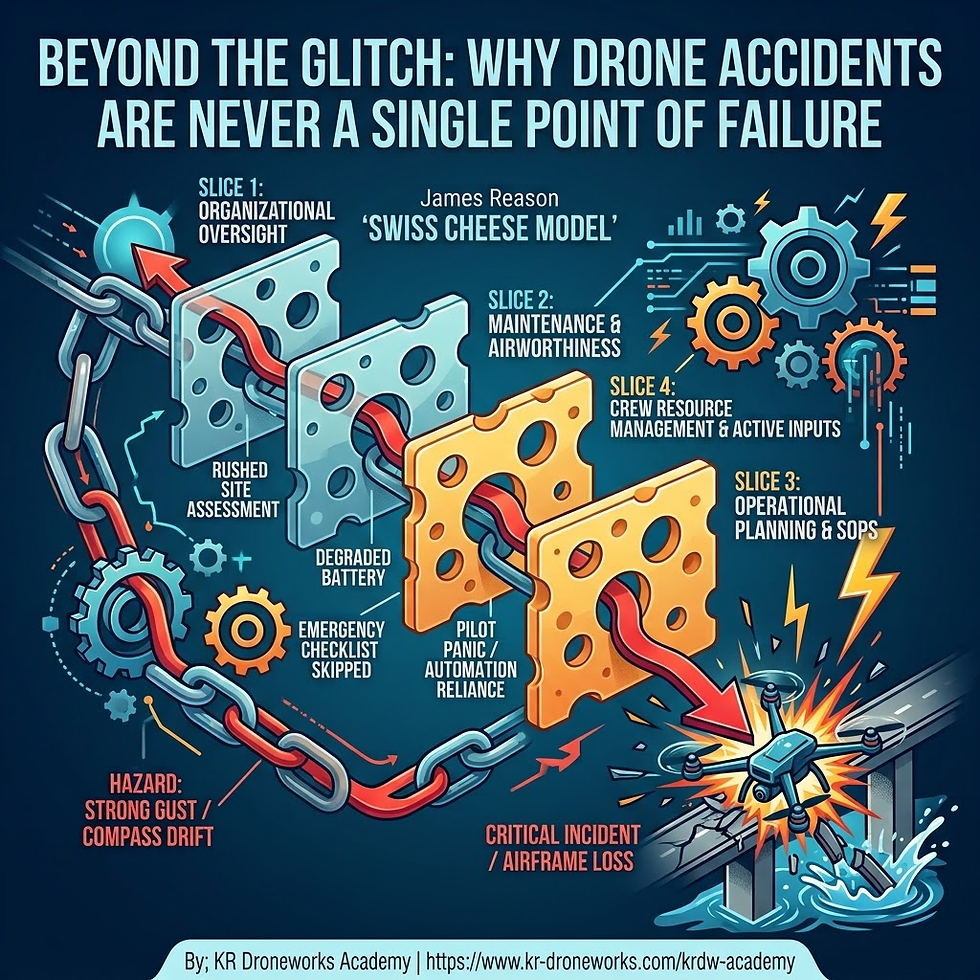
In aviation safety, accidents are rarely the result of a single failure. Instead, they follow the Swiss Cheese Model: multiple layers of defense (technology, regulations, procedures) all happen to have "holes" that align at the exact wrong moment.
In the LaGuardia event, the holes included:
Cognitive Overload: Air traffic controllers (ATCs) are currently understaffed and managing record-high traffic volumes.
Communication Breakdown: The "I messed up" admission over the radio suggests a failure in situational awareness or a slip in standard operating procedures (SOPs).
Expectancy Bias: When a pilot is cleared to land, they expect a clear runway. When a driver is cleared to cross, they expect no traffic. This bias slows the reaction time when reality contradicts the "plan."
Relating to Drone Operations: Level 1 Complex & BVLOS
As we transition from basic VLOS (Visual Line of Sight) to Level 1 Complex operations in Canada and similar frameworks globally, the stakes shift. We are no longer just "flying a drone"; we are managing a distributed crew system.
1. The Distributed Cockpit
In a BVLOS mission, the "cockpit" is split between the Remote Pilot in Command (RPIC) at the Ground Control Station (GCS) and the Visual Observers (VOs) or automated Detect-and-Avoid (DAA) systems.
Human Factor Challenge: Unlike a traditional cockpit where the Captain can see what the First Officer is doing, a drone crew relies entirely on mediated communication. If a VO sees a Cessna 172 entering the area but uses ambiguous language (e.g., "There's a plane over there!"), the RPIC lacks the spatial data to make a split-second avoidance maneuver.
2. Level 1 Complex Environments
Level 1 Complex allows for operations over sparsely populated areas or near aerodromes. These are "congested" in terms of risk.
The Fire Truck Lesson: Just as the LaGuardia collision happened on the ground, many drone risks occur during takeoff and landing or due to ground incursions (people or vehicles entering the launch/recovery zone). Human Factors training must extend to the ground crew, not just the pilot.
The Critical Role of Trained Visual Observers (VOs)
A "trained" VO is not just someone standing in a field looking up. In a complex BVLOS environment, the VO is a critical safety sensor.
Effective VO training must emphasize:
Standardized Phraseology: Using "Clock positions" (e.g., "Traffic, 2 o'clock, high, moving left to right") to reduce the RPIC’s cognitive load.
Scanning Techniques: Understanding how the human eye perceives motion vs. stationary objects at distance to prevent "target fixation."
Sterile Cockpit Rule: Ensuring no non-essential conversation during critical phases (launch, approach, or when traffic is nearby).
Crew Resource Management (CRM): The Antidote to Chaos
The industry's answer to Human Factors is CRM. Originally designed for multi-pilot flight decks, CRM is now essential for drone teams.
CRM Component | Application in Drone BVLOS |
Situational Awareness | Maintaining a mental map of the drone, the terrain, and the surrounding "intruder" aircraft. |
Problem Solving | Using a structured framework (like the DECIDE model) rather than reacting on instinct. |
Communication | Closing the loop: "Traffic identified," "Roger, descending to 200ft." |
Leadership/Followership | The RPIC has final authority, but the VO has a "duty to speak up" if they perceive a hazard. |
The Bottom Line: Training is Not a Box to Check
The LaGuardia accident reminds us that even highly regulated, professional environments are susceptible to human error. In the drone world, as we add more crew members and fly in more complex airspace, training is the only thing that narrows the holes in the Swiss Cheese.
If your BVLOS operation treats the VO as an afterthought or skips CRM briefings, you aren't just flying a drone—you're waiting for your "near miss" to become a "direct hit."
#AviationSafety #DroneTech #BVLOS #HumanFactors #RPAS #FlightSafety #AirCanada #LGA #PilotTraining #UAS

Comments