


Enhancing Drone Safety Through Action: Incorporating Shisa Kanko into RPAS Checklist Protocols
By: Colonel (ret) Bernie Derbach, KR Droneworks Academy, 15 Sep 26
Please note: The concepts, methodology, and operational frameworks presented in this article are purely conceptual ideas intended for discussion, debate, and further study within the professional RPAS community.
Introduction: Beyond the Passive Mental Check
In the rapidly evolving world of Remotely Piloted Aircraft Systems (RPAS), safety management systems have borrowed heavily from legacy manned aviation. Standard Operating Procedures (SOPs) and rigorous pre-flight checklists form the bedrock of flight safety. However, even the most meticulous written checklist suffers from a critical human vulnerability: operational fatigue and cognitive automaticity.
When a pilot or visual observer executes the same checklist hundreds of times, a phenomenon known as "autopilot brain" sets in. The eyes glide over a switch, the mind assumes it is in the correct position, and a checkmark is rendered without actual cognitive confirmation. In high-stakes RPAS operations—where single-point mechanical failures or unlatched components can lead to immediate crashes or fly-aways—passive checking is a silent hazard.
To combat this, the drone industry is looking toward a century-old railway safety protocol developed in Japan: Shisa Kanko (指差喚呼), commonly translated as Pointing-and-Calling.
By demanding physical, visual, and vocal involvement for every single checklist line item, Shisa Kanko converts a passive reading exercise into an active sensory loop. This article explores the conceptual integration of Pointing-and-Calling into RPAS operations, specifically utilizing the structured operational framework of the KR Droneworks DJI Mini 5 Pro Operating and Emergency Response Plan (SOP Checklists, Canadian Edition).
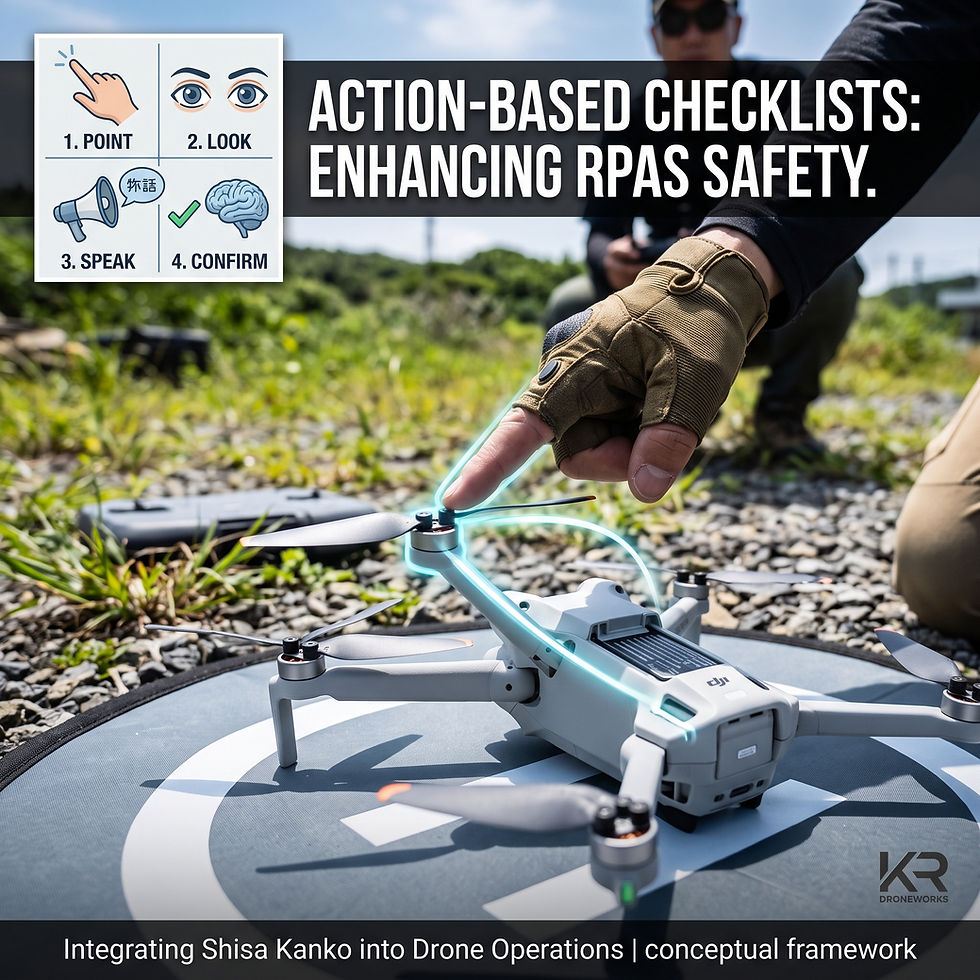
The Science of Shisa Kanko: Point, Look, Speak, Confirm
Originally developed by the Japanese Railway National System in the early 20th century, Shisa Kanko was designed to eliminate signal overshoot and mechanical oversights among train operators. The physical act of pointing at an indicator while speaking its status aloud was shown by the Japanese Railway Technical Research Institute to reduce workplace errors by over 80 percent compared to simple visual inspection.
The protocol relies on four interconnected sensory mechanisms:
Point (Physical Target): The operator physically extends their index finger and points directly at the physical component, screen icon, or status LED. This engages the brain's motor cortex, forcing the operator to physically locate the target rather than glance vaguely in its direction.
Look (Visual Focus): The operator fixates their gaze directly on the specific tip of their finger, isolating the visual target from surrounding distractions.
Speak (Audible Callout): The operator vocally announces the target's name and its active condition clearly and distinctly (e.g., "Battery latch, locked!").
Confirm (Auditory Feedback Loop): The operator’s brain processes their own spoken words, creating a cognitive feedback loop that verifies whether the announced state matches the required standard before moving to the next item.
In single-pilot operations, this process keeps the remote pilot in command (RPIC) fully present. In multi-crew operations involving Visual Observers (VOs) or Flight Assistants (FAs), it establishes unambiguous Crew Resource Management (CRM), ensuring every crew member physically hears and sees the verification.
Deconstructing the KR Droneworks DJI Mini 5 Pro Checklist
The KR Droneworks DJI Mini 5 Pro SOP Checklist (V3.4) provides an ideal baseline for evaluating Shisa Kanko. Despite its classification under 250 grams, the Mini 5 Pro is a high-performance aircraft capable of advanced operations. Furthermore, given manufacturing tolerances where individual units may weigh up to 253.9 grams—requiring formal registration and pilot certification under Canadian Aviation Regulations—rigorous SOP compliance is paramount.
The KR Droneworks publication structures flight phases into distinct sequential modules:
Pre-Deployment Checklists
Site Setup, Safety and Security Checklists
Pre-Start, RPAS Inspection and Setup Checklists
Start & Pre-Takeoff Checklists
Post-Takeoff and Mission Progress Checklists
Approach and Landing Checklists
Emergency Response Protocols
Integrating Shisa Kanko does not require rewriting these procedures; rather, it changes how the crew interacts with each checklist line item.
Step-by-Step Practical Application Across Flight Phases
Phase 1: Pre-Start RPAS Inspection and Airframe Setup
During the physical assembly and inspection of the aircraft, human error often manifests as unsecured latches, dirty optics, or missed structural damage. Applying Shisa Kanko transforms page 18 of the KR Droneworks manual into an active physical sweep:
Intelligent Flight Battery Installation: Rather than simply sliding the battery in, the pilot slides the battery, physically points at the battery latch, visually aligns with the engagement seam, and calls out: "Battery contacts clean, inserted and locked—LOCKED!"
Arm Deployment Sequence: The pilot unfolds the front and rear arms. Pointing at each arm hinge in succession: "Front arms unfolded, rear arms unfolded, auto power-on confirmed—SECURE!"
Propeller and Motor Inspection: The pilot physically touches and points at each motor bell and blade pair individually: "Propeller 1, no nicks, screws secure, free rotation—CHECKED! Propeller 2, free rotation—CHECKED!"
Gimbal and Optics: Pointing directly at the camera housing: "Gimbal cover removed, lens clean, filters secure, movement free—CLEAR!"
Phase 2: Remote Controller and Display Setup
Moving to the control station (page 19), pointing-and-calling ensures software parameters and control links are verified before power is applied to the motors:
Antenna Orientation: Pointing at the foldable antennas: "Antennas unfolded, adjusted, angle set—OPTIMAL!"
Control Sticks: Pointing at the control stick threads: "Control sticks attached, centered, movement smooth—SECURE!"
Safety Toggles: Navigating to the DJI Fly App safety menu, pointing directly at the screen toggles: "Obstacle avoidance BRAKE mode set, Max Altitude set, Auto RTH altitude set—VERIFIED!"
Phase 3: Start, Pre-Takeoff, and Launch
The Start and Takeoff phase (pages 21–22) represents the final boundary between ground operations and active flight. Here, Shisa Kanko reinforces communication between the
Designated Pilot-in-Command (DPIC) and the Visual Observer (VO).
GNSS Link Verification: The DPIC points at the satellite counter icon on the display screen: "GNSS lock established, eighteen satellites—LOCK CONFIRMED!"
Home Point Callout: Listening for the audio notification from the controller, the DPIC points at the green Home Point icon mapped on the telemetry display: "Home point updated on map—CONFIRMED!"
Power & Status LEDs: Pointing at the aircraft rear status indicators: "Status indicators blinking green, normal state—READY!"
Crew Launch Dialogue: The DPIC points toward the open airspace/launch pad: "Clear to start?" The VO points at the perimeter and surrounding airspace: "Area clear of bystanders and hazards, cleared to start!" The DPIC points at the aircraft motors upon start: "Starting engines, motors spinning smoothly—LAUNCHING!"
Phase 4: Emergency Response Protocols
In emergency conditions, stress causes cognitive tunneling, making pilots prone to skipping steps. Shisa Kanko acts as an anchor, forcing deliberate, deliberate actions when executing critical non-routine checks.
Lost Control Link (Page 36): The DPIC immediately points at the disconnect indicator on the controller: "Lost control link!" The VO responds by pointing up at the aircraft's last known visual location: "Acknowledged, maintaining VLOS!" The DPIC physically points at the controller antennas, adjusts them, and points at the screen status: "Adjusting antenna angle, checking battery level—ATTEMPTING RECONNECTION!"
Emergency Fly-Away Script (Page 38–39): If an un-commanded departure occurs, execution of the mandatory reporting script requires absolute accuracy under high pressure. The designated crew member points at each telemetry field on the screen while reading the script to ATC or ACC Shift Managers: "Drone last seen heading [POINT AT COMPASS] two-seven-zero degrees, altitude [POINT AT ALTITUDE DISPLAY] three hundred feet, remaining battery [POINT AT BATTERY ICON] forty-five percent!" Pointing directly at each telemetry readout eliminates reading errors during a crisis.
Implementation Challenges and Operational Best Practices
While the benefits of Shisa Kanko are demonstrable, adopting it into an active RPAS operational culture requires overcoming key challenges:
Self-Consciousness and Culture: Operators unused to Pointing-and-Calling may feel awkward physically pointing and speaking aloud to themselves on a site. Flight leads must cultivate a culture where vocalization is recognized as professional discipline rather than theater.
Environmental Noise: On industrial or high-wind deployment sites, spoken callouts can be drowned out. In these scenarios, the physical gesture of pointing must be amplified, and crew members should utilize two-way radios (GMRS/iCOM) as outlined in the KR Droneworks equipment lists.
Pacing: Pointing-and-calling inherently slows down checklist execution by a few seconds per item. Operational management must recognize that these extra seconds represent a deliberate investment in risk mitigation, preventing costly airframe losses or regulatory violations.
Conclusion: A Conceptual Framework for Safety Innovation
As drone technology becomes increasingly automated, the human element remains both the most adaptable asset and the primary point of failure in the operational chain. Integrating Shisa Kanko into standardized RPAS frameworks—such as the KR Droneworks DJI Mini 5 Pro SOP manual—offers a pragmatic, zero-cost method to elevate flight discipline.
By forcing the brain to point, look, speak, and confirm, drone operators can bridge the gap between reading a checklist and truly executing it. As a conceptual framework, Pointing-and-Calling invites debate, testing, and refinement across commercial, industrial, and public safety RPAS divisions.
References & External Reading
National Institute of Occupational Safety and Health (Japan) - Research on the Effectiveness of Pointing and Calling: https://www.jniosh.johas.go.jp/en/
Transport Canada - Remotely Piloted Aircraft System Safety Resources and CARs Part IX: https://tc.canada.ca/en/aviation/drone-safety
Occupational Safety and Health Administration (OSHA) - Human Factors and Error Reduction Protocols: https://www.osha.gov/
Federal Aviation Administration (FAA) - Pilot’s Handbook of Aeronautical Knowledge (Chapter 2: Human Factors): https://www.faa.gov/regulations_policies/handbooks_manuals/aviation/phak


Comments