


Are You Ready for Your Canadian RPAS Advanced or Level 1 Complex Flight Review?
By: Colonel (ret) Bernie Derbach, KR Droneworks Academy, 29 July 26
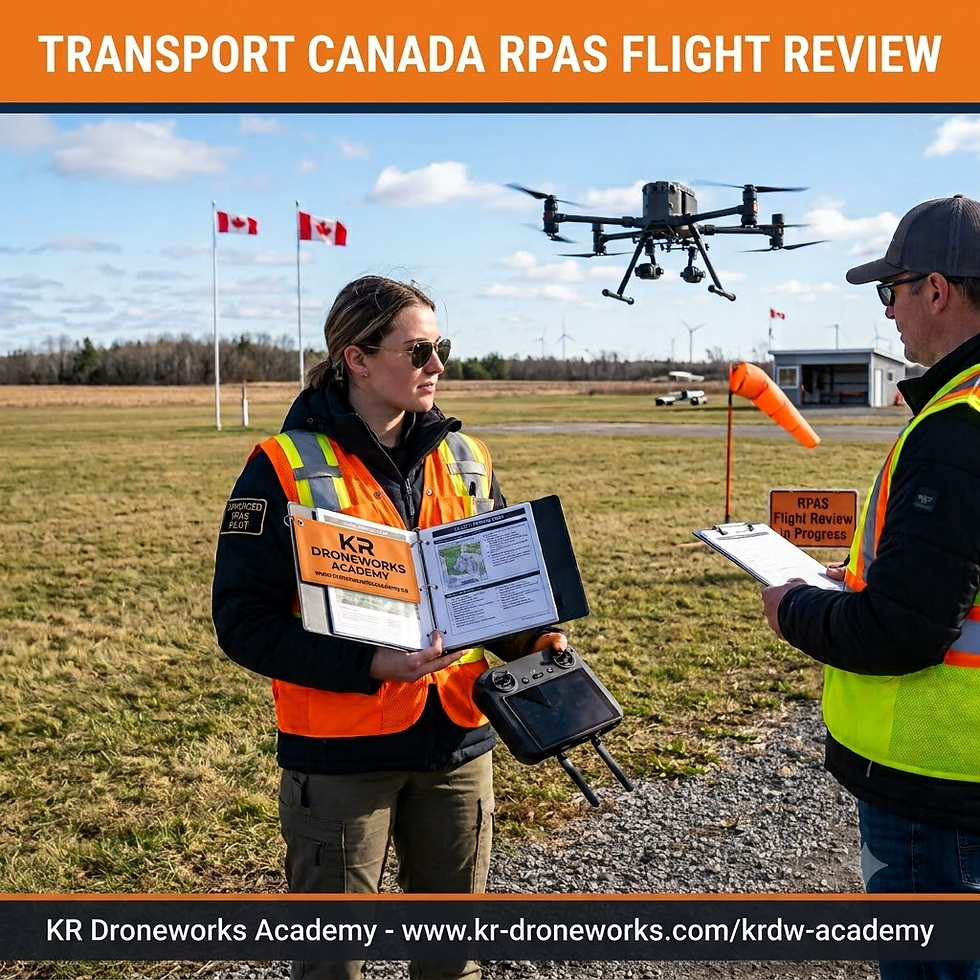
Are You Ready for Your Canadian RPAS Advanced or Level 1 Complex Flight Review?
Taking your Transport Canada (TC) online exam is a major milestone, but passing that multiple-choice test only covers half the equation. To earn your Pilot Certificate for Advanced Operations or Level 1 Complex Operations, you have to face a Transport Canada Flight Reviewer for an in-person, practical Flight Review (FR).
For many RPAS (Remotely Piloted Aircraft System) pilots, the Flight Review is where anxiety sets in. But here is the secret: it doesn’t have to be a mystery.
Here is everything you need to know to prepare, understand what Transport Canada is evaluating, and pass your Flight Review with confidence.
1. Transport Canada’s Primary Objective: Safety and Decision-Making
Transport Canada’s primary goal during a Flight Review is not to see if you can pull off acrobatic maneuvers or fly like a stunt pilot. Their core objective is to verify that you are a safe, law-abiding pilot who can exercise sound aeronautical decision-making (ADM).
According to Transport Canada’s publication TP 15395 – Flight Reviewer’s Guide for Pilots of Remotely Piloted Aircraft Systems, the reviewer evaluates your ability to:
Plan and execute a flight legally and safely within the Canadian Aviation Regulations (CARs - Part IX).
Perform a thorough site survey and identify ground, air, and radio hazards.
Inspect and manage your equipment before, during, and after flight.
Handle unexpected emergencies calmly and systematically.
Essential Tip: Transport Canada’s Flight Reviewer’s Guide (TP 15395) is a public document. Every RPAS pilot preparing for an FR should download and read it. It acts as the exact grading rubric your reviewer will use—telling you line-by-line what exercises you will be tested on, how points are awarded, and what causes an automatic failure.
2. Advanced vs. Level 1 Complex FRs: What’s the Difference?
While both reviews test your foundational airmanship, the operational scope and standards step up significantly between Advanced and Level 1 Complex:
Operational Aspect | Advanced Operations Flight Review | Level 1 Complex Flight Review |
Operational Scope | Controlled airspace (Classes C, D, E), within 30 meters of bystanders, or over built-up areas. | Expanded parameters including lower-risk Beyond Visual Line-of-Sight (BVLOS), operations over people, or complex infrastructure environments. |
Site Planning & SOPs | Standard site survey, basic hazard identification, and standard emergency procedures. | Higher-level risk assessments, robust company Standard Operating Procedures (SOPs), and strict site containment strategies. |
Crew Resource Management | Single-pilot resource management, visual observer (VO) briefing if applicable. | Advanced Crew Resource Management (CRM), formal radio callouts, clear multi-crew task delegation, and air traffic coordination. |
Reviewer Focus | Basic flight proficiency, airspace awareness, and safety protocols. | Operational discipline, system redundancies, strict adherence to manual/SOP suites, and contingency management under higher operational risk. |
3. Why Online "Test-Prep" Schools Are Not Enough
A major trap many candidate pilots fall into is relying exclusively on quick, online multiple-choice test prep courses.
While these courses can help you memorize facts long enough to pass the computer exam, they often fail to teach practical application.
Relying on test prep alone to take a Flight Review is like trying to earn a Private Pilot License by reading a book without ever sitting in the cockpit.
During a Flight Review, a reviewer will not ask you multiple-choice questions—they will hand you a scenario, point to a field, and ask:
"Show me your site survey for this location."
"Where is the nearest control zone boundary?"
"What is your contingency plan if a low-flying helicopter enters this corridor right now?"
If you haven't practiced creating real-world site surveys, running physical checklists, and making real-time aviation decisions, memorizing exam answers won't save you. You need practical, hands-on flight preparation that bridges regulation into real-world operations.
4. Emergency Procedures: Know Them Cold
If there is one section of the Flight Review where reviewers hold zero tolerance, it is emergency procedures.
When something goes wrong in the air, you do not have time to scroll through a manual on your phone. You must demonstrate quick, methodical control. During your FR, expect the reviewer to throw simulated emergencies at you mid-flight, such as:
Lost Link / Flyaway: What is your failsafe altitude set to? Which way will the aircraft head? What is your immediate callout?
Airspace Intrusion: A low-altitude air ambulance or crop duster enters your area. What is your evasive maneuver, and who yields right-of-way?
Battery Malfunction / Thermal Runaway: How do you land immediately, and what are your ground safety isolation steps?
GPS / Sensor Failure: Can you immediately switch to Manual/Attitude mode (or maintain manual control) and fly the drone back safely without relying on automated positioning systems?
Rule of Thumb: Practice your emergency checklists until the initial actions (Fly, Navigate, Communicate) become muscle memory.
5. How to Prepare Step-by-Step for Your Flight Review
To show up to your review looking like a seasoned professional, follow this pre-review prep checklist:
A. Prepare Your Documentation Portfolio
Bring organized hard copies or clean digital files of:
Your Exam Results Page showing a passing grade on the Advanced or Level 1 Complex exam.
Government-issued ID.
Drone Registration Certificate issued by Transport Canada.
Aircraft Flight Manual / User Manual (including safety guidelines).
Maintenance Log and Flight Logs proving your aircraft is airworthy and up-to-date.
Standard Operating Procedures (SOPs) & Emergency Checklists.
B. Conduct a Proper Site Survey
Before meeting your reviewer, complete a written site survey for the review location. It should document:
Airspace classification and nearby aerodromes/helipads.
Micro-meteorological conditions and weather forecasts (METAR/TAF/GFA if applicable).
Ground hazards, bystanders, powerlines, obstacles, and emergency landing zones.
Emergency contact numbers (local air traffic control, local emergency services).
C. Master the Physical Flight Exercises
Practice the standard flight maneuvers outlined in TP 15395:
Pre-flight inspection & crew briefing (even if you are the sole pilot, speak your checks out loud).
Precise hover control (figure-eights, nose-in hovers, square patterns).
Manual flight adjustments without relying on automated tracking or collision avoidance sensors.
Precision landings within a specified zone.
Final Thoughts: Mindset is Everything
Approach your Flight Review not as an adversarial test, but as a professional evaluation between colleagues. If you show up organized, know your emergency drills cold, and demonstrate a safety-first mindset, you will walk away with your certificate in hand.

Comments