


What Happened in the Drone Universe This Week, January 2, 2026
By: Colonel (ret) Bernie Derbach, KR Droneworks, 02 Jan 2026

Welcome to the first 2026 edition of our weekly roundup. The first week of the New Year has not just been a celebration of a new calendar, but a foundational shift in the regulatory and commercial landscape of the drone industry.
From aggressive new national security mandates in the United States to a revolutionary opening of Canadian airspace for complex operations, the "Drone Universe" has never looked more dynamic—or more complicated.
In this expanded deep dive, we break down the major international headlines, the local Canadian regulatory breakthroughs, and the critical compliance deadlines that took effect on January 1st.
Part I: International News Updates
1. The FCC "Covered List" Activation: A New Era for U.S. Markets
The most significant global news of the week centers on the U.S. Federal Communications Commission (FCC). As of January 1, 2026, the FCC has officially updated its "Covered List" to include several prominent foreign-made drones and their critical communications components, citing "unacceptable risks to national security."
While the industry has been bracing for a "DJI Ban" for years, this week’s implementation is broader than many anticipated.
The Scope: The ban targets new equipment authorizations. This means while you can still fly the drone you bought last year, manufacturers like DJI and Autel cannot receive FCC certification for new models.
The Agricultural Crisis: National farming groups, including the American Soybean Association, have voiced extreme concern. In the U.S., foreign-made drones—specifically large-scale sprayers—make up nearly 80% of the agricultural market. Farmers are warning that a lack of affordable domestic alternatives could drive up production costs significantly in 2026.
The "Origin Assurance" Trend: This move is sparking a massive shift toward "NDAA-compliant" (National Defense Authorization Act) hardware. Manufacturers in the U.S., Europe, and "Five Eyes" allied nations are seeing a surge in pre-orders as agencies rush to replace fleets with "trusted" hardware.
2. Major Military Contracts: The eBee TAC and the Marine Corps "10,000 Drone" Push
Military and tactical applications continue to lead drone innovation. On January 2, 2026, EagleNXT (formerly AgEagle) announced a successful sale of six eBee TAC tactical mapping drones to the U.S. Army.
The Tech: These fixed-wing units are equipped with S.O.D.A. 3D and Duet M sensors, offering centimeter-level accuracy without the need for ground control points.
The Trend: Simultaneously, the U.S. Marine Corps announced a massive procurement goal for 2026: purchasing 10,000 new small-sized platforms for under $4,000 per unit. Their goal is to have every infantry and reconnaissance team equipped with FPV (First-Person View) and attack-capable drones by May 2026.
3. Boeing’s Strategic Exit: The Sale of Insitu
In a surprising business move on New Year’s Day, Boeing announced it is exploring the sale of its subsidiary, Insitu, for an estimated $500 million. Insitu is a pioneer in long-range military surveillance drones (like the ScanEagle). Boeing’s decision is reportedly part of a wider effort to offload non-core assets to pay down over $50 billion in debt. This sale could signal a consolidation in the mid-to-high-tier military drone market as private equity firms eye these established defense contractors.
Part II: Canadian News Updates
The first week of 2026 marks a "coming of age" for the Canadian drone industry. Following years of consultations, Transport Canada has finally unlocked the potential for commercial pilots to scale their operations.
1. The Launch of "Level 1 Complex" BVLOS
As of January 1, 2026, Canada’s new Part IX amendments are fully operational. The most exciting development is the Level 1 Complex Operation certification. This allows pilots to fly Beyond Visual Line-of-Sight (BVLOS) in uncontrolled airspace without the tedious requirement of a Special Flight Operations Certificate (SFOC).
The Requirement: Pilots must be 18+, hold an Advanced Certificate, complete 20 hours of specific ground school, and pass a flight review.
The Impact: This is a game-changer for pipeline inspections, forestry, and large-scale agricultural mapping. What used to take weeks of paperwork and visual observers every few kilometers can now be done with a single certified pilot and a high-end autonomous platform.
2. The "Sheltered Operations" Revolution
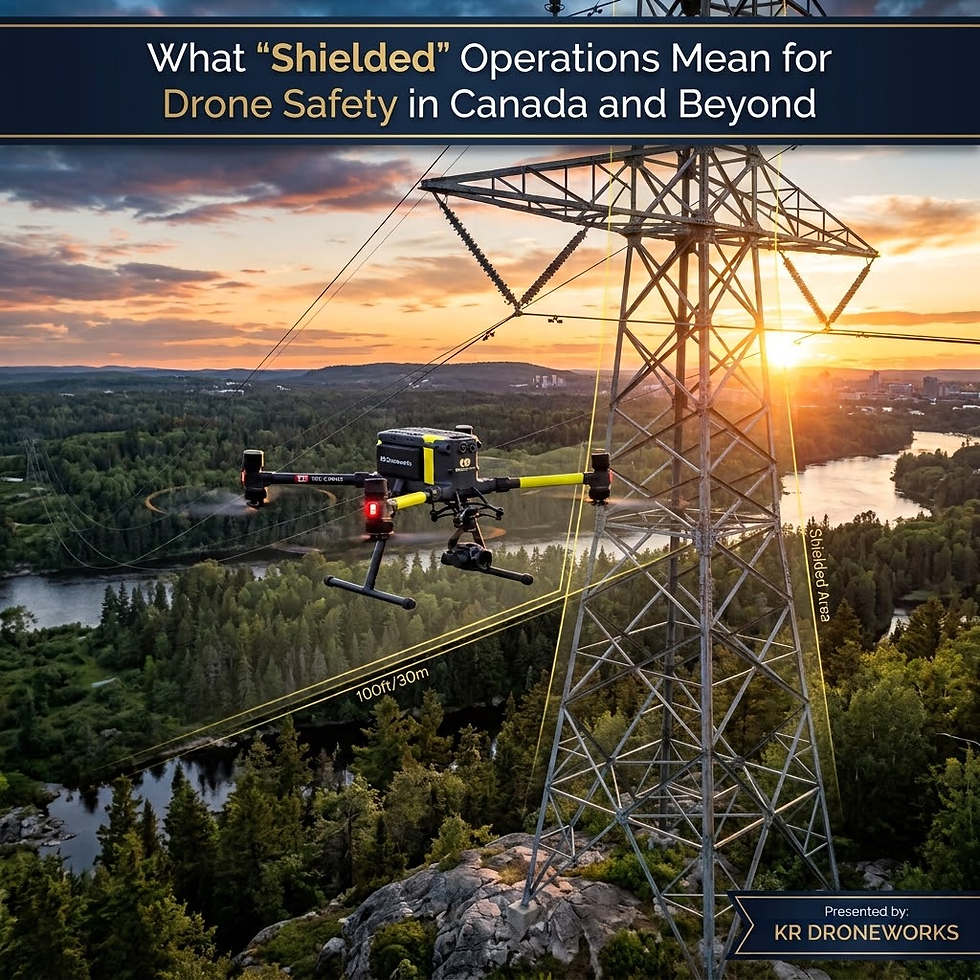
For urban operators in Ontario and beyond, the new Sheltered Operations rule is the highlight of the week.
The Rule: Pilots can now fly small drones within 61m (200ft) horizontally and 30m (100ft) vertically of a structure—even in controlled airspace. Controlled Airspace: The operation can take place in controlled airspace. However, you must still request and obtain an RPAS Flight Authorization from NAV CANADA using the NAV Drone app or web portal.
Depending on specific altitude thresholds for the location, the authorization may be granted automatically through the app, but it is not a blanket "no authorization needed" for every flight in controlled airspace.
Practical Use: Real estate photographers and facade inspectors can now "hug" buildings to get the shots they need, safely shielded from higher-altitude manned aircraft traffic.
3. Medium Drones (25kg - 150kg) Enter the Mainstream
Previously, any drone over 25kg required an SFOC, treating it more like a manned aircraft than a consumer drone. Under the new rules active this week, Medium Drones can now operate within VLOS in both controlled and uncontrolled airspace, provided the manufacturer has filed a Safety Assurance Declaration. This opens the door for heavy-lift delivery drones and large-scale agricultural sprayers to work legally and frequently across the Canadian Prairies.
Part III: Regulatory Changes & Deadlines (Effective Jan 1, 2026)
The following table summarizes the mandatory changes that operators must adhere to as of this week:
Jurisdiction | Regulation / Standard | Mandatory Action for Operators |
Canada | CARs Part IX Phase 2 | Upgrade to Level 1 Complex Certificate for BVLOS flights. |
United States | FCC Covered List Update | No new authorizations for foreign (DJI/Autel) models. |
United Kingdom | UK Class Marking (UK0-UK6) | All new drones must carry a UK Class Mark; Flyer ID required for drones over 100g. |
European Union | U-Space Integration | Mandatory Remote ID and geo-awareness for all "Open Category" flights. |
Ontario | Labour Mobility Act | 10-day fast-track for out-of-province drone pilot certification recognition. |
Global Compliance Spotlight: The UK's "Class Mark" System
Across the pond, the UK’s Civil Aviation Authority (CAA) officially transitioned to its own UK Class Marking system on January 1st. While EU "C-Class" marks will be recognized until December 2027, all new models entering the UK market must now bear a UK0 through UK6 stamp. Crucially, the weight threshold for mandatory registration in the UK has dropped to 100g for any drone with a camera—a strict move compared to the traditional 250g global standard.
Summary of the Week’s Impact
The theme of early 2026 is Sovereignty and Scaling. While the U.S. and UK are tightening the leash on where hardware comes from and how it is labeled, Canada has chosen to widen the sky for its pilots. For the commercial operator, this means 2026 will be the year of Recertification. Whether you are studying for your Level 1 Complex in Canada or auditing your fleet for FCC compliance in the U.S., the "wild west" era of drones is officially over, replaced by a sophisticated, professionalized aviation sector.
Reference Section
Transport Canada (2025/2026): 2025 Summary of Changes to Canada’s Drone Regulations - Beyond Visual Line-of-Sight. [Link to TC Portal]
Federal Communications Commission (FCC): Public Notice: Update to the List of Equipment and Services That Pose an Unacceptable Risk to National Security. (Jan 1, 2026).
Stock Titan News: EagleNXT Announces Successful Drone and Sensor Sale to U.S. Army. (Jan 2, 2026).
UK Civil Aviation Authority (CAA): CAP 722: Unmanned Aircraft System Operations in UK Airspace – 2026 Edition.
DefenseScoop: U.S. Marine Corps 2026 Procurement Strategy: Small UAS and FPV Training Initiatives. (Jan 2, 2026).
Farm Progress America: Impact of the 2026 FCC Drone Ban on Precision Agriculture. (Dec 31, 2025).
NAV CANADA: NAV Drone App Update: Integration of Sheltered and EVLOS Operational Categories. (Nov 2025).

Comments