


TC RPAS Advanced Pilot Study Guide

TC RPAS Advanced Pilot Study Guide
The Advanced Operations Exam consists of 50 multiple-choice questions with a 60-minute time limit and an 80% (40/50) passing score. Your study should focus on understanding the context and application of the rules, not just memorizing the text.
I. Knowledge Area Answers and Details
1. Air Law, Air Traffic Rules and Procedures 🇨🇦
Core Reference: CARs Part IX (Remotely Piloted Aircraft Systems) & TC AIM RPA Section.
Requirement | Detailed Answer | Reference |
Airspace Rules | Controlled Airspace (Class A, B, C, D, E): Requires a NAV CANADA authorization before flight. Class F Special Use Airspace (Restricted, Advisory, or Danger) requires permission from the responsible party (often DND or the airspace owner/user). | CAR 900.03, CAR 901.40 |
Aerodrome Proximity | Certified Aerodrome/Airport: Cannot operate within 5.6 km (3 NM) of a runway unless coordinating with the aerodrome operator. Certified Heliport: Cannot operate within 1.9 km (1 NM) unless coordinating with the heliport operator. | CAR 901.47 |
Proximity to People | General rule is 30 m (100 ft) standoff from bystanders. Advanced Privilege: Can operate within 5 m (15 ft) of bystanders using an RPAS on the TC-approved list for advanced operations. Flying Over People: Requires an SFOC or an RPA equipped with a TC-approved parachute system (or equivalent means). | CAR 901.25, CAR 901.62 |
Pilot Currency | A pilot must complete a Recency Activity every 24 months to maintain certificate validity (e.g., passing an exam, completing a flight review, or a TC-endorsed seminar). | CAR Standard 921.04 |
Registration | All RPAs weighing 250 g or more must be registered and display the registration number (either internal or external). | CAR 901.02, CAR 901.03 |
2. RPAS Airframes, Power Plants, Propulsion and Systems
Core Reference: TP 15263 & Manufacturer's Manuals.
Requirement | Detailed Answer | Reference |
Flight Control System | Flight Controller: The "brain" integrating inputs from sensors (GPS, IMU, Barometer, Magnetometer) and converting them into motor commands. IMU (Inertial Measurement Unit) contains gyroscopes and accelerometers for attitude sensing. | TP 15263, Sec 2 |
Battery Management | LiPo Batteries are volatile; store at a storage charge (3.8V/cell), inspect for swelling/damage, and follow Transportation of Dangerous Goods (TDG) regulations for transport (especially on commercial airliners). | TP 15263, Sec 2 |
Data Links | C2 (Command and Control) Link: The radio connection between the pilot and the RPA. Requires Radio Line-of-Sight for best performance. Know how to assess and manage Radio Frequency (RF) Interference in the operating environment. | TP 15263, Sec 2 |
Ground Station | Importance of antenna placement (e.g., maintaining polarization alignment) and software version control to ensure compatibility and stability. | TP 15263, Sec 2 |
3. Human Factors
Core Reference: Human Factors for Aviation - Basic & Advanced Handbooks (TP 12863/12864).
Requirement | Detailed Answer | Reference |
Fit to Fly | IMSAFE checklist (Illness, Medication, Stress, Alcohol, Fatigue, Emotion/External Pressure). The Alcohol Rule is 12 hours bottle-to-throttle (or residual effects have passed). | CAR 602.03 |
Decision Making | Hazardous Attitudes (e.g., Anti-authority, Impulsivity, Invulnerability, Macho, Resignation) must be recognized and countered with corresponding safe attitudes. DECIDE Model (Detect, Estimate, Choose, Identify, Do, Evaluate) for structured decision-making. | TP 15263, Sec 3, TP 12863 |
Situational Awareness | The accurate perception of elements in the environment. Maintaining VLOS and effective communication with a Visual Observer (VO) is crucial for situational awareness in the RPAS environment. | TP 15263, Sec 3 |
CRM | Crew Resource Management focuses on effective use of all resources (personnel, equipment, procedures) to achieve safe operations. Includes proper briefing/debriefing and clear role definition. | TP 15263, Sec 3, TP 12864 |
4. Meteorology
Core Reference: TC AIM (MET Section) & TP 15263.
Requirement | Detailed Answer | Reference |
Density Altitude | The pressure altitude corrected for non-standard temperature. High density altitude (hot, humid, high elevation) means less air density, resulting in reduced lift, longer takeoff run, and poorer RPA performance. | TC AIM MET |
Aviation Weather | METAR (Meteorological Aerodrome Report) is an observation of current conditions. TAF (Terminal Aerodrome Forecast) is a forecast of conditions within 5 NM of an airport. Be able to decode common terms (e.g., OVC, RA, VRB). | TC AIM MET |
Stability | Unstable air (convective, typically hot surface) leads to good visibility, bumpy flight, and showers/thunderstorms. Stable air (cool surface) leads to poor visibility, smooth flight, and stratus clouds/fog. | TC AIM MET |
Icing/Freezing | All forms of airframe icing (clear, rime, mixed) are hazardous. RPAS flights must be cancelled or mitigated if freezing precipitation or freezing fog is present or forecast, as the RPA is not typically certified for flight in icing conditions. | TP 15263, Sec 4 |
5. Navigation
Core Reference: VNC/VTA Charts, Canada Flight Supplement (CFS) & TC AIM (NAV Section).
Requirement | Detailed Answer | Reference |
Chart Interpretation | VFR Navigation Charts (VNC) for regional planning, VFR Terminal Area Charts (VTA) for detailed operations near major airports. Interpret Airspace Boundaries, Maximum Elevation Figures (MEF), and Obstacles. | TC AIM NAV |
Time Conversion | Convert local time to UTC (Universal Coordinated Time), often referred to as Zulu (Z) time, by adding or subtracting the appropriate time difference based on the Time Zone. | TC AIM GEN |
CFS | Used to find detailed information about aerodromes, including runway headings, lengths, operating hours, lighting, and contact information for coordination. | CFS |
Compass/Bearing | Understanding the difference between True North and Magnetic North, and how to apply Magnetic Variation found on VNC/VTA charts. | TC AIM NAV |
6. Flight Operations
Core Reference: CARs Part IX, TP 15263, Flight Reviewer's Guide (TP 15395).
Requirement | Detailed Answer | Reference |
Site Survey/Planning | Must include assessment of the airspace, weather, surface hazards, obstacles, emergency landing areas, and population density before flight. | TP 15263, Sec 6 |
Aerodrome Operations | Be familiar with Standard Traffic Patterns (typically left-hand circuit) and avoid interfering with manned aircraft. Understand Runway Numbering (magnetic heading rounded to the nearest tenth). | TC AIM RAC |
Checklists | Essential for ensuring system health and following procedures. Must include Pre-flight, Pre-takeoff, Landing, and Emergency items. | TP 15263, Sec 6 |
Accident Reporting | Must report accidents (e.g., loss of life, serious injury, or major damage/collision with manned aircraft) to the Transportation Safety Board (TSB). Other incidents must be recorded internally. | CAR 901.55 |
7. Theory of Flight
Core Reference: TP 15263 & TC AIM (AER Section).
Requirement | Detailed Answer | Reference |
Four Forces | Lift (opposes weight, generated by rotors/props), Weight (force of gravity), Thrust (moves RPA forward/vertical), and Drag (opposes thrust). | TP 15263, Sec 7 |
Control Axes | Longitudinal Axis (Roll), Lateral Axis (Pitch), Vertical Axis (Yaw). Know the control surface/mechanism that primarily controls movement around each axis (e.g., rotor tilt/differential thrust). | TP 15263, Sec 7 |
Aerodynamics | Principles of Angle of Attack (AoA) and how it relates to lift generation. Understanding Bernoulli's Principle (faster air = lower pressure) and its role in lift. | TP 15263, Sec 7 |
Load Factor | The ratio of lift to weight. In a level turn, the Load Factor is greater than 1, increasing the effective weight on the RPA and increasing the stall speed/power required. | TC AIM AER |
8. Radiotelephony
Core Reference: TC AIM (COM Section) & RIC-21 (ROC-A Study Guide).
Requirement | Detailed Answer | Reference |
Radio Use | While not mandatory for RPAS operations, the ability to monitor relevant air traffic frequencies (ATF, MF, UNICOM) is critical for situational awareness, especially near uncontrolled aerodromes. | TP 15263, Sec 8 |
Procedures | Proper phraseology, clear and concise communication. Mandatory use of the ICAO Phonetic Alphabet (Alpha, Bravo, Charlie, etc.) and understanding the difference between Mandatory Frequency (MF) and Aerodrome Traffic Frequency (ATF) areas. | TC AIM COM |
Lost Comms | Procedures to follow upon loss of the radio link while operating in controlled airspace (e.g., continuation or termination of the flight as pre-planned and coordinated). | TP 15263, Sec 8 |
II. 75 Multiple Choice Practice Questions
Section 1: Air Law, Air Traffic Rules and Procedures (20 Questions)
What is the maximum altitude an RPA pilot can fly above ground level (AGL) without a Special Flight Operations Certificate (SFOC)?
a) 90 meters (300 ft)
b) 122 meters (400 ft)
c) 150 meters (500 ft)
d) 300 meters (1000 ft)
What is the minimum standoff distance a pilot operating a non-approved small RPA must maintain from bystanders?
a) 5 meters (15 ft)
b) 15 meters (50 ft)
c) 30 meters (100 ft)
d) 45 meters (150 ft)
For a small RPAS that is on the Transport Canada approved list for Advanced Operations, what is the minimum distance a pilot may operate from a bystander?
a) 30 meters
b) 5 meters
c) 15 meters
d) No minimum distance
An Advanced Pilot wishes to fly within the 5.6 km buffer zone of a Certified Airport. What action is required before operating?
a) Obtain an SFOC from Transport Canada.
b) Obtain permission from the Regional ATC office.
c) Coordinate with and obtain permission from the aerodrome operator.
d) Notify NAV CANADA via the NAV Drone app only.
What class of airspace requires a NAV CANADA authorization for Advanced RPAS Operations?
a) Class G only
b) Class A, B, C, D, and E
c) Class F (Advisory) only
d) Class G and Class F (Restricted)
If an Advanced RPA pilot has not completed a Recency Activity in the last 24 months, their Pilot Certificate is considered:
a) Suspended and must be re-written.
b) Void and a new flight review must be completed.
c) Lacking currency and cannot be used until a recency activity is performed.
d) Valid only for Basic Operations.
Who is responsible for ensuring the RPA is maintained in accordance with the manufacturer's recommendations?
a) The Flight Reviewer
b) Transport Canada
c) The RPA pilot or operator
d) The RPA manufacturer
What is the mandatory maximum speed limit for an RPAS operating VLOS?
a) 50 knots
b) 87 knots
c) There is no specific speed limit defined in CARs Part IX for VLOS.
d) 100 km/h
An RPA is flying 350 ft AGL over a large industrial building that is 200 ft tall. Is this operation in compliance with the altitude rule?
a) No, the maximum flight height is 400 ft above the building, not AGL.
b) No, the RPA must stay 400 ft AGL from the ground.
c) Yes, the pilot is not more than 122m (400 ft) AGL and not more than 30m above the highest obstacle.
d) Yes, because it is more than 300 ft AGL.
A pilot consumes alcohol at 09:00 and plans to fly an RPA at 20:00 on the same day. Assuming they feel fit to fly, are they legally allowed to operate the RPAS?
a) Yes, as long as they are fit to fly.
b) Yes, because the operation is not near an aerodrome.
c) No, the 12-hour alcohol rule must be respected.
d) No, because RPAS operations are prohibited after civil twilight.
What is the minimum age to hold an Advanced RPAS Pilot Certificate?
a) 14 years old
b) 15 years old
c) 16 years old
d) 18 years old
An RPA is considered a "Small RPAS" if its maximum take-off weight is:
a) 10 kg or less
b) Between 250 g and 25 kg
c) Less than 250 g
d) Between 25 kg and 150 kg
What is the minimum separation distance required from the center of a Certified Heliport to operate an RPAS without coordinating with the operator?
a) 5.6 km (3 NM)
b) 3.7 km (2 NM)
c) 1.9 km (1 NM)
d) 1.5 km
What document must be carried by the pilot at the control station during an Advanced Operation?
a) Proof of insurance
b) The TC AIM
c) The Pilot Certificate and RPA Registration Certificate
d) The RPA’s bill of sale
What is the general rule for operating an RPA over a person?
a) It is allowed if the person is a member of the crew.
b) It is allowed if the RPA is under 250g.
c) It is prohibited unless authorized by an SFOC or using an approved system.
d) It is allowed at an altitude of 100 ft AGL or higher.
What is the primary purpose of a Visual Observer (VO) in an EVLOS operation?
a) To operate the flight controls in an emergency.
b) To monitor the equipment and battery status.
c) To maintain visual contact with the RPA and monitor the airspace, assisting the pilot with separation.
d) To communicate with ATC or the aerodrome operator.
Operations in Class F Restricted Airspace require:
a) A Basic Pilot Certificate.
b) Coordination with NAV CANADA only.
c) Permission from the user or controlling agency of the airspace.
d) Monitoring the specified radio frequency only.
Which CARs Part IX Division covers the general prohibition from operating an RPA in a reckless or negligent manner?
a) Division I
b) Division II
c) Division III
d) Division IV
Flying an RPA that has sustained damage that could affect its airworthiness is a violation of which CAR?
a) CAR 901.19 (Pilot responsibilities)
b) CAR 901.40 (Airspace restrictions)
c) CAR 901.12 (Condition of RPA)
d) CAR 901.47 (Aerodrome operations)
When operating a medium RPA (25kg–150kg), what certificate is generally required?
a) Basic Operations Certificate
b) Advanced Operations Certificate
c) A Special Flight Operations Certificate (SFOC)
d) A Commercial Pilot Licence
Section 2: RPAS Airframes, Power Plants, Propulsion and Systems (10 Questions)
What component in a multi-rotor RPA primarily provides the aircraft with its attitude and velocity data?
a) The GPS module
b) The Electronic Speed Controller (ESC)
c) The Inertial Measurement Unit (IMU)
d) The Barometer
In LiPo battery charging, what is the term for the rating that indicates the maximum safe discharge and charge rate (e.g., 20C)?
a) Watt-hour rating
b) C-Rating
c) Amp-hour rating
d) Voltage rating
A loss of the Command and Control (C2) link is most likely to result in which default safety action?
a) Immediate vertical descent.
b) Continued flight along the last received vector.
c) Activation of the Return-to-Home (RTH) procedure.
d) Power cut to all motors.
What are the two types of radio frequency systems generally used for RPAS data links?
a) VHF and UHF
b) Licensed (e.g., cellular) and Unlicensed (e.g., 2.4/5.8 GHz)
c) Satellite and Terrestrial
d) AM and FM
What is the primary purpose of a pre-flight maintenance check on propellers/rotors?
a) To ensure they are magnetically shielded.
b) To verify the pitch angle is correct for the flight plan.
c) To inspect for chips, cracks, or damage that could lead to failure and imbalance.
d) To confirm they are the correct color for visibility.
Why is proper antenna orientation and polarization important at the Ground Control Station (GCS)?
a) To prevent battery discharge.
b) To avoid interference with the GPS signal.
c) To maximize the signal-to-noise ratio and maintain a robust C2 link.
d) To comply with magnetic variation requirements.
What is the primary function of a brushless DC motor in an RPAS?
a) To store electrical energy.
b) To manage power distribution to the components.
c) To convert electrical energy into mechanical rotational force (thrust).
d) To measure the RPA’s acceleration.
Which of the following is an unacceptable storage condition for LiPo batteries?
a) Stored at a charge of 3.8V per cell.
b) Stored in a cool, dry, fireproof container.
c) Stored at room temperature.
d) Stored at full charge for an extended period.
The Barometer in an RPAS is primarily used to provide data for:
a) Altitude hold and vertical speed sensing.
b) Horizontal position tracking.
c) Attitude stabilization.
d) Magnetic heading reference.
If a component on the RPA is listed in the manufacturer’s manual as "unserviceable," what action is the pilot required to take before flight?
a) Consult with the Visual Observer.
b) Log the damage and proceed cautiously.
c) Ensure the RPA is airworthy or have the component repaired/replaced by an authorized person.
d) Limit flight time to 5 minutes.
Section 3: Human Factors (10 Questions)
Which Hazardous Attitude is best countered by the safe attitude, "I'm not perfect, I need to check my plan and equipment."?
a) Macho
b) Anti-authority
c) Invulnerability
d) Resignation
The DECIDE decision-making model starts with:
a) Choosing the best course of action.
b) Detecting the fact that a change has occurred.
c) Estimating the significance of the change.
d) Doing the best action.
What is the primary impact of fatigue on a pilot's performance?
a) Increased physical strength.
b) Degradation of decision-making, reaction time, and vigilance.
c) Improved color perception.
d) Enhanced memory recall.
A Visual Observer (VO) reports seeing another aircraft in the distance, but the pilot cannot spot it yet. What is the pilot's best immediate course of action regarding Situational Awareness?
a) Ignore the report until the pilot can see the aircraft.
b) Immediately land the RPA.
c) Acknowledge the VO, cease flight movement, and prioritize locating the manned aircraft.
d) Increase altitude to avoid the traffic.
The purpose of using checklists in a flight operation is:
a) Primarily for record-keeping.
b) To satisfy Transport Canada auditors.
c) To ensure all critical steps are performed systematically and accurately.
d) To shorten pre-flight time.
An Advanced Pilot is experiencing external pressure from a client to fly in marginal weather to meet a deadline. This is a threat to:
a) Technical competence.
b) Financial viability.
c) Aeronautical Decision Making (ADM).
d) CRM effectiveness.
What is Spatial Disorientation?
a) Loss of GPS signal.
b) Failure of the magnetic compass.
c) A pilot's incorrect perception of their position and attitude relative to the earth.
d) Confusion about which control stick to use.
Which Human Factor is primarily addressed by implementing a thorough pre-flight crew briefing?
a) Fatigue
b) Crew Resource Management (CRM)
c) Invulnerability
d) Alcohol consumption
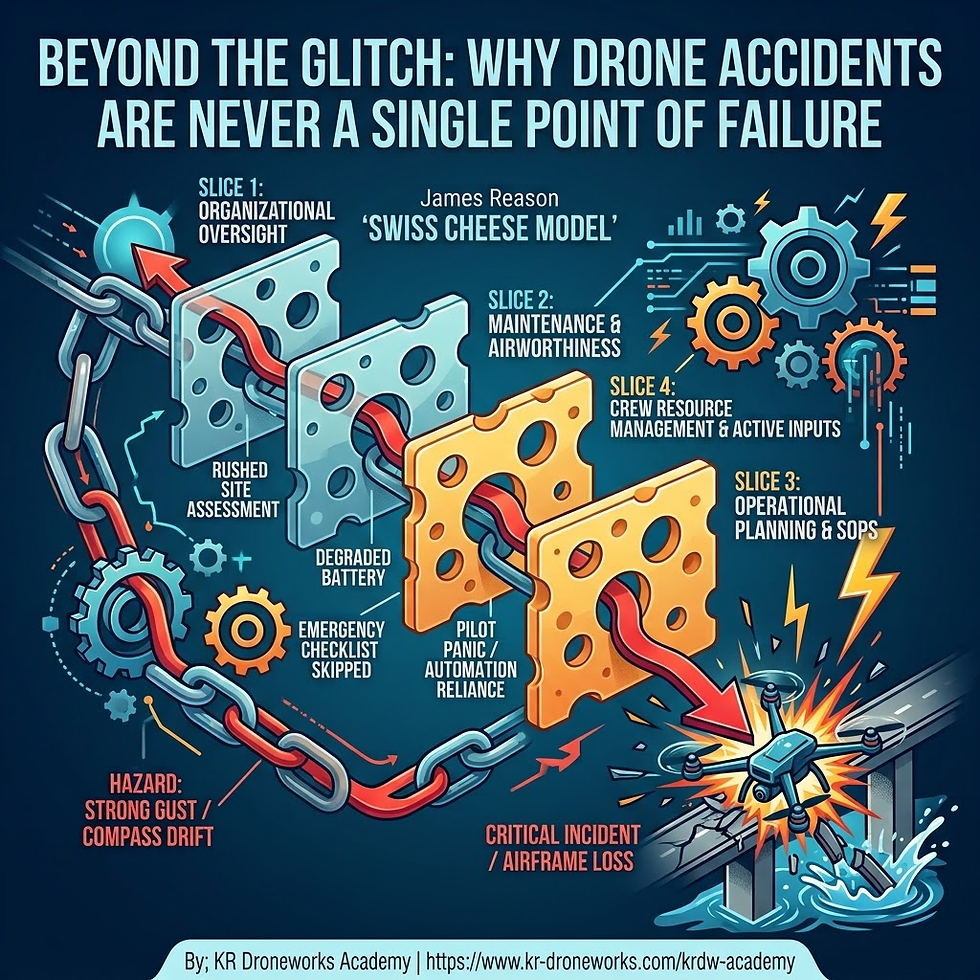
The concept of Error Chain in human factors suggests that:
a) Only one major error causes an accident.
b) Accidents are typically the result of a sequence of smaller, manageable errors.
c) Errors can always be eliminated through automation.
d) Checklists are ineffective against all types of errors.
An Advanced Pilot must be able to recognize the physical signs of hypoxia (lack of oxygen). While rare at typical RPAS altitudes, what is a key symptom?
a) Increased focus
b) Hyperactivity
c) Impaired judgment and euphoria
d) Immediate pain
Section 4: Meteorology (10 Questions)
Density Altitude is affected by which three variables?
a) Wind speed, cloud coverage, and dew point.
b) Temperature, pressure, and humidity.
c) Visibility, precipitation, and ceiling height.
d) Magnetic variation, latitude, and longitude.
What condition results in the poorest performance (lowest air density) for an RPA?
a) Cold temperature, high pressure.
b) Cold temperature, low pressure.
c) High temperature, low pressure, high humidity.
d) High temperature, high pressure, low humidity.
Which weather report provides a forecast of wind, visibility, and weather within 5 nautical miles of an airport?
a) TAF (Terminal Aerodrome Forecast)
b) METAR (Meteorological Aerodrome Report)
c) PIREP (Pilot Report)
d) NOTAM (Notice to Airmen)
Cumulus clouds are characteristic of what type of atmospheric stability?
a) Stable air
b) Unstable air
c) Neutral stability
d) Stratified layers
Wind shear is defined as a rapid change in wind direction or speed:
a) With a change in longitude only.
b) Only near the ground.
c) Over a short distance, either vertically or horizontally.
d) Only above 10,000 ft ASL.
What type of icing forms when large supercooled water droplets strike the airframe and spread out before freezing, creating a hard, clear sheet?
a) Rime ice
b) Mixed ice
c) Clear ice
d) Hoar frost
A low-pressure system is generally associated with:
a) Descending air, good weather, and clear skies.
b) Ascending air, poor visibility, and precipitation.
c) Calm winds and stable air.
d) High density altitude.
Decoding the METAR code "TSRA" indicates:
a) Heavy snow and freezing rain.
b) Thunderstorm and freezing rain.
c) Thunderstorm and moderate rain.
d) Tornado warning.
What is the impact of mechanical turbulence caused by buildings in an urban environment?
a) Creates predictable, smooth airflow.
b) Creates unpredictable, strong wind gusts and eddies.
c) Causes the pressure to rise, improving RPA lift.
d) Eliminates the need for a site survey.
The freezing level is the altitude at which the temperature is $0^\circ\text{C}$. What is the most significant hazard to an RPA flying at this level with visible moisture?
a) Density altitude
b) Airframe icing
c) Magnetic variation
d) Loss of GPS
Section 5: Navigation (5 Questions)
On a VFR Navigation Chart (VNC), the blue circle and lines with a bold 'A', 'B', 'C', or 'D' indicate what type of airspace?
a) Uncontrolled Airspace
b) Class F Airspace
c) Controlled Airspace (Class B, C, or D)
d) Military Training Area
The time zone used in international aviation and found on aviation documents is:
a) Local Standard Time (LST)
b) Daylight Saving Time (DST)
c) Coordinated Universal Time (UTC) / Zulu (Z) Time
d) Eastern Standard Time (EST)
The Maximum Elevation Figure (MEF) shown in a large quadrant on a VNC chart indicates:
a) The highest point of controlled airspace in the quadrant.
b) The highest operating altitude for RPAS.
c) The highest known obstruction or terrain feature in that quadrant, expressed in feet ASL.
d) The maximum height of the control tower.
A runway is numbered 09. What is its magnetic heading?
a) 9 degree
b) 090 degrees
c) 180 degrees
d) 270 degrees
Where would a pilot find the detailed operating hours and contact information for a non-towered aerodrome in Canada?
a) The TC AIM
b) The VFR Terminal Area Chart (VTA)
c) The Canada Flight Supplement (CFS)
d) The RPAS Registration Portal
Section 6: Flight Operations (10 Questions)
When must an RPA accident that results in a serious injury to a person be reported to the Transportation Safety Board (TSB)?
a) Only if the RPA is over 25 kg.
b) Only if the RPA strikes a manned aircraft.
c) Immediately, regardless of the RPA's weight (as it meets the criteria for reportable accidents).
d) Within 72 hours.
The standard traffic pattern flown by manned aircraft at non-towered aerodromes is a:
a) Right-hand circuit
b) Left-hand circuit
c) Straight-in approach
d) Figure-eight pattern
What is the primary purpose of a pre-flight site survey in an Advanced Operation?
a) To determine the density altitude.
b) To identify hazards, assess risk, and confirm the legal airspace status and surface conditions.
c) To practice emergency procedures.
d) To calibrate the GPS.
If an RPA loses its C2 link, the pilot should immediately:
a) Contact ATC for instructions.
b) Monitor the pre-programmed failsafe action (e.g., RTH) and be prepared to execute a contingency plan.
c) Change the flight path manually.
d) Stop the mission and pack up.
Maintenance records for an RPA should include:
a) Only battery charge cycles.
b) Only the date of purchase.
c) A record of all repairs, modifications, and inspections.
d) Only the pilot's flight hours.
What does the term “due diligence” mean in the context of RPAS operations?
a) Passing the exam with 80% or higher.
b) Taking all reasonable steps and precautions to prevent harm or injury.
c) Only flying during the day.
d) Buying a drone with high-quality components.
Before conducting a complex operation near a railway, a prudent pilot should coordinate with:
a) NAV CANADA.
b) The local police.
c) The railway company/authority.
d) Transport Canada.
Which condition requires a pilot to terminate a flight?
a) The battery level drops to 50%.
b) Loss of the Visual Line-of-Sight (VLOS) with the RPA (unless operating under an EVLOS authorization).
c) A cloud appears on the horizon.
d) The RPA reaches 300 ft AGL.
What is the primary difference between an Advanced Flight Review and the Basic Exam?
a) The Flight Review is shorter.
b) The Flight Review is a practical demonstration of flight proficiency and adherence to safety procedures.
c) The Basic Exam is open-book.
d) The Flight Review focuses only on Air Law.
A Serious Injury that requires TSB reporting includes which of the following?
a) A scratch requiring a bandage.
b) A fracture of any bone (except fingers/toes/nose).
c) A minor burn.
d) A slight headache.
Section 7: Theory of Flight (5 Questions)
What are the four forces acting on an aircraft in flight?
a) Torque, Pitch, Roll, Yaw
b) Lift, Drag, Thrust, Roll
c) Lift, Weight, Thrust, Drag
d) Power, Speed, Altitude, Attitude
What force directly opposes Lift?
a) Thrust
b) Drag
c) Weight
d) Yaw
The Lateral Axis controls motion in:
a) Roll
b) Yaw
c) Pitch
d) Thrust
In a level turn, the Load Factor:
a) Remains at 1.0.
b) Increases above 1.0, increasing the effective weight.
c) Decreases below 1.0, reducing the effective weight.
d) Is only a factor in fixed-wing aircraft.
The faster speed of air over the curved upper surface of a propeller (airfoil) is key to generating Lift, a phenomenon primarily explained by:
a) Newton's First Law.
b) Boyle's Law.
c) Bernoulli's Principle.
d) Newton's Second Law.
Section 8: Radiotelephony (10 Questions)
When communicating via radio, the ICAO phonetic alphabet must be used for:
a) All words in the transmission.
b) Only the pilot's name.
c) Transmitting letters and numbers that require clarity (e.g., call signs, runway numbers, altitudes).
d) Only when speaking to ATC.
What is the purpose of listening to the ATF (Aerodrome Traffic Frequency) at an uncontrolled aerodrome?
a) To transmit a mandatory clearance.
b) To comply with the ROC-A license requirement.
c) To build situational awareness of manned aircraft operations in the vicinity.
d) To obtain a NOTAM.
The proper way to state the altitude 400 feet in an aviation context is:
a) "Four hundred"
b) "Four zero zero feet"
c) "Four hundred feet"
d) "Zero point four thousand"
If a pilot wishes to transmit on an aviation frequency, what separate certificate is generally required?
a) An SFOC
b) An Advanced Pilot Certificate
c) A Restricted Operator Certificate—Aeronautical (ROC-A)
d) A Commercial Pilot Licence
What is the standard procedure when making an initial radio call on an ATF?
a) State only the RPA’s registration number.
b) Identify who you are calling, who you are, your position, altitude, and your intentions.
c) Immediately ask for landing clearance.
d) Only report the RPA’s battery status.
III. Answer Key and References
Q # | Ans | TC Knowledge Area | Reference(s) |
1 | B | Air Law | CAR 901.25 |
2 | C | Air Law | CAR 901.25 |
3 | B | Air Law | CAR 901.62 |
4 | C | Air Law | CAR 901.47 |
5 | B | Air Law | CAR 901.40 |
6 | C | Air Law | CAR Standard 921.04 |
7 | C | Air Law | CAR 901.12 |
8 | C | Air Law | CAR 901 (VLOS speed not regulated) |
9 | C | Air Law | CAR 901.25(2) (30m above obstacle exception) |
10 | C | Air Law | CAR 602.03 (12-hour rule) |
11 | C | Air Law | CAR 903.03 |
12 | B | Air Law | CAR 900.01 (Small RPAS definition) |
13 | C | Air Law | CAR 901.47 |
14 | C | Air Law | CAR 901.19 |
15 | C | Air Law | CAR 901.62 |
16 | C | Air Law | TP 15263, Sec 1 (EVLOS) |
17 | C | Air Law | CAR 901.40 |
18 | C | Air Law | CAR 901.15 (Reckless or negligent operation) |
19 | C | Air Law | CAR 901.12 |
20 | C | Air Law | CAR 903.01 |
21 | C | Airframes | TP 15263, Sec 2 |
22 | B | Airframes | TP 15263, Sec 2 |
23 | C | Airframes | TP 15263, Sec 2 |
24 | B | Airframes | TP 15263, Sec 2 |
25 | C | Airframes | TP 15263, Sec 2 |
26 | C | Airframes | TP 15263, Sec 2 |
27 | C | Airframes | TP 15263, Sec 2 |
28 | D | Airframes | TP 15263, Sec 2 |
29 | A | Airframes | TP 15263, Sec 2 |
30 | C | Airframes | CAR 901.12 |
31 | C | Human Factors | TP 12863/12864 |
32 | B | Human Factors | TP 12863/12864 |
33 | B | Human Factors | TP 15263, Sec 3 |
34 | C | Human Factors | TP 15263, Sec 3 |
35 | C | Human Factors | TP 15263, Sec 3 |
36 | C | Human Factors | TP 12863/12864 |
37 | C | Human Factors | TP 15263, Sec 3 |
38 | B | Human Factors | TP 15263, Sec 3 |
39 | B | Human Factors | TP 12863/12864 |
40 | C | Human Factors | TP 15263, Sec 3 |
41 | B | Meteorology | TC AIM MET |
42 | C | Meteorology | TC AIM MET |
43 | A | Meteorology | TC AIM MET |
44 | B | Meteorology | TC AIM MET |
45 | C | Meteorology | TC AIM MET |
46 | C | Meteorology | TC AIM MET |
47 | B | Meteorology | TC AIM MET |
48 | C | Meteorology | TC AIM MET |
49 | B | Meteorology | TP 15263, Sec 4 |
50 | B | Meteorology | TP 15263, Sec 4 |
51 | C | Navigation | TC AIM NAV / VNC Charts |
52 | C | Navigation | TC AIM GEN |
53 | C | Navigation | VNC Charts |
54 | B | Navigation | TC AIM RAC (Runway Numbering) |
55 | C | Navigation | CFS |
56 | C | Flight Operations | TSB Regulations / CAR 901.55 |
57 | B | Flight Operations | TC AIM RAC |
58 | B | Flight Operations | TP 15263, Sec 6 |
59 | B | Flight Operations | TP 15263, Sec 6 |
60 | C | Flight Operations | TP 15263, Sec 6 |
61 | B | Flight Operations | General Aviation Law / CAR 901.15 |
62 | C | Flight Operations | TP 15263, Sec 6 (Coordination with ground users) |
63 | B | Flight Operations | CAR 901.18 |
64 | B | Flight Operations | TP 15395 |
65 | B | Flight Operations | TSB Regulations |
66 | C | Theory of Flight | TP 15263, Sec 7 |
67 | C | Theory of Flight | TP 15263, Sec 7 |
68 | C | Theory of Flight | TP 15263, Sec 7 |
69 | B | Theory of Flight | TC AIM AER (Load Factor) |
70 | C | Theory of Flight | TP 15263, Sec 7 |
71 | C | Radiotelephony | TC AIM COM |
72 | C | Radiotelephony | TP 15263, Sec 8 |
73 | C | Radiotelephony | TC AIM COM |
74 | C | Radiotelephony | RIC-21 |
75 | B | Radiotelephony | TC AIM COM |

Comments