


Explaining the Updated Transport Canada Standards 922.07, 922.08, 922.09, 922.10, 922.11, and 922.12
By: Colonel (ret) Bernie Derbach, KR Droneworks, 19 Jan 26

Here's a blog post explaining the updated Transport Canada RPAS Standards 922.07 through 922.12, why they're important, and their impact on drone pilots.
The world of Remotely Piloted Aircraft Systems (RPAS), or drones, is constantly evolving, and so are the regulations designed to keep our skies safe. In Canada, Transport Canada (TC) has been steadily refining its framework for advanced drone operations. Among the most significant updates are a series of standards – 922.07 through 922.12 – which lay the groundwork for how advanced drone operations are approved and conducted.
If you're a drone pilot looking to push the boundaries of your operations, understanding these standards isn't just helpful; it's essential.
What are These Standards All About?
These standards are part of the RPAS Safety Assurance framework, designed to allow more complex and higher-risk drone operations, such as flying:
Over people
In controlled airspace
Beyond Visual Line-of-Sight (BVLOS)
Unlike basic rules that focus on pilot certification and operational limits, these standards dive deep into the technical capabilities of the drone itself, as well as the operational procedures. They require manufacturers or operators to demonstrate that their drone system is safe and reliable enough for the intended advanced operation.
Let's break them down:
922.07: Safety and Reliability
This is the foundation. It requires that the drone's design minimizes the chance of pilot error and ensures that a single system failure cannot lead to a catastrophic crash. It targets a level of reliability where critical failures are "extremely improbable."
922.08: Containment
This standard ensures that the drone stays within its designated operational volume and does not fly away. This standard sets out requirements for geofencing, lost-link procedures, and potentially flight termination systems to prevent the drone from entering unauthorized or unsafe areas. Robust containment is crucial for public safety and for preventing incursions into sensitive airspace.
922.09: Command and Control (C2) Link
This standard focuses on the "invisible tether" between the remote and the drone. It sets requirements for link reliability and—crucially—dictates how the drone must behave if that link is lost (e.g., predictable Return-to-Home or auto-land).
922.10: Detect, Alert, and Avoid (DAA) Systems
Vital for BVLOS operations. This standard ensures the drone can detect other aircraft or hazards and alert the pilot with enough time to take action. It uses "risk ratios" to prove the system is effective at preventing mid-air collisions.Why Are These Standards Required?
922.11: Control Station Design
This isn't about the aircraft, but the pilot's interface. It ensures that the controls are clear, unambiguous, and provide all necessary information for the pilot to manage the flight and respond to emergencies effectively.
922.12: Demonstrated Environmental Envelope
These standards require manufacturers to prove exactly what conditions (temperature, wind, humidity) the drone can handle through rigorous ground and flight testing.
These standards are essential for several reasons:
Safety: At their core, they enhance safety for both the public on the ground and other aircraft in the sky. As drones become more capable and ubiquitous, robust safety measures are non-negotiable.
Integration into Airspace: They provide a pathway for drones to operate safely within Canada's existing national airspace system, alongside manned aircraft, enabling advanced operations that were previously impossible or highly restricted.
Risk Mitigation: For advanced operations that inherently carry higher risks (e.g., BVLOS over populated areas), these standards provide a framework to demonstrate that these risks have been thoroughly identified, analyzed, and mitigated to an acceptable level.
Innovation and Growth: By clearly defining safety requirements, Transport Canada enables innovation within the drone industry. Manufacturers know what they need to achieve, fostering the development of more sophisticated and safer RPAS technologies.
Public Trust: Establishing rigorous technical standards helps build public confidence in drone technology, paving the way for wider acceptance and integration of RPAS into daily life and various industries.
Impact on RPAS Pilots Flying Their Drones
For the average recreational or basic operational drone pilot, these standards might seem distant, focusing more on manufacturers and complex operations. However, their impact is significant:
Gateway to Advanced Operations: If you aspire to conduct operations "over people," "in controlled airspace," or "BVLOS," you must use a drone system that has been declared compliant with the relevant 922 series standards. Without such a declaration, you'll be limited to Basic or Visual Line-of-Sight (VLOS) Advanced Operations.
Product Availability: These standards directly influence the types of drones available on the market for advanced operations. Manufacturers will design and build drones to meet these requirements, leading to more reliable and safer commercial platforms.
Operational Complexity: Utilizing a compliant drone for advanced operations often means adhering to specific operational procedures outlined in the drone's flight manual and your own RPAS Safety Case (for a Special Flight Operations Certificate - SFOC). These procedures will be designed around the capabilities and limitations proven by these standards.
Proof of Safety: As a pilot applying for an SFOC for complex operations, you'll often need to reference the manufacturer's compliance with these standards as part of your application to demonstrate your overall safety case.
Increased Confidence: Flying a drone that meets these rigorous standards provides greater confidence in the reliability and safety of your equipment, allowing you to focus more on the mission and less on potential system failures.
The "SAD" List is Your Shopping Guide: Before buying a drone for professional use, you must check the Safety Assurance Declaration (SAD) list. A drone might be "Advanced" rated for controlled airspace (922.04) but not rated for BVLOS (922.07–922.12). You cannot legally fly a mission if the drone isn't declared for that specific standard.
Strict Operational Limits: Under 922.12, pilots are legally bound by the "Environmental Envelope." If the manufacturer declares the drone safe to -10 {C} and you fly at -15 {C}, you are in violation of the Canadian Aviation Regulations (CARs).
The Role of Standard 922 in New Advanced Capabilities

1. Sheltered Operations (Small Drones Only)
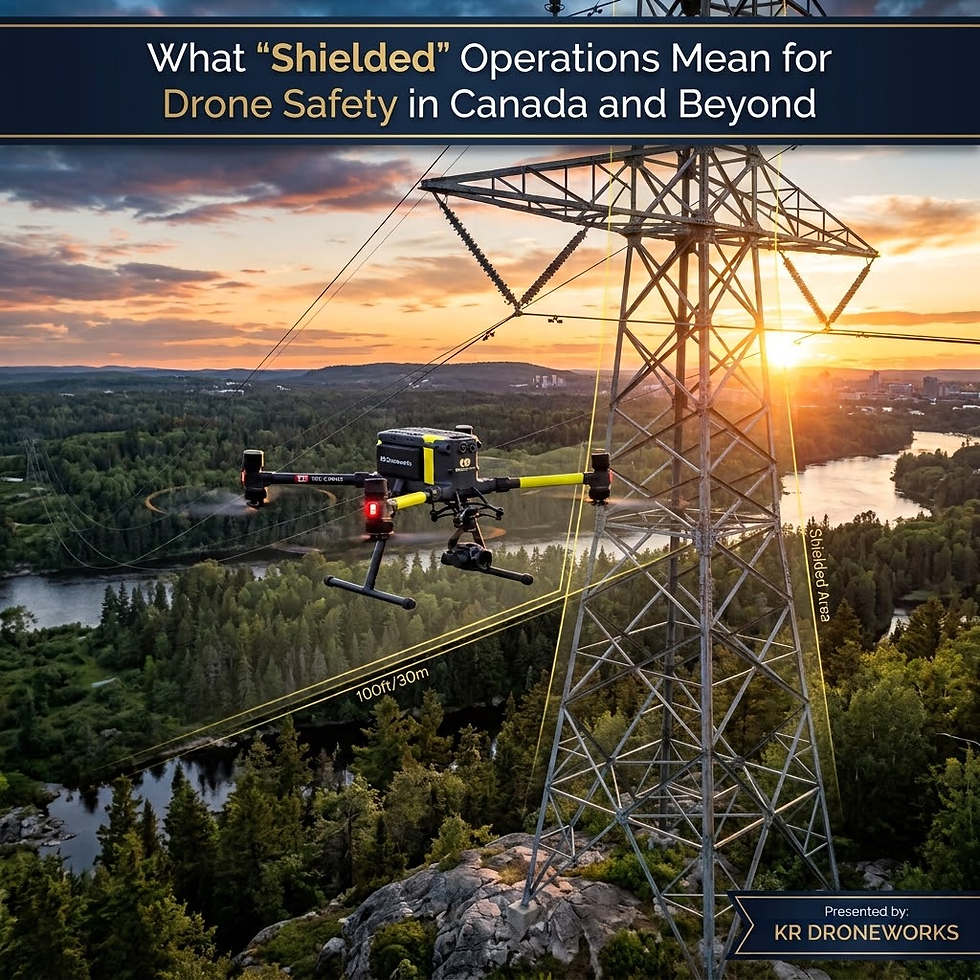
A "Sheltered Operation" allows you to fly a small drone around a structure without a visual line of sight or a visual observer, provided you stay within 200ft (61m) horizontally and 100ft (30m) vertically of that structure.
Impact of 922.04: If your sheltered operation takes place in controlled airspace, the drone must have a Safety Assurance Declaration for Standard 922.04.
The Reality: For sheltered operations in uncontrolled airspace, TC focuses on operational distances (staying 30m away from bystanders) rather than requiring the high-reliability hardware standards like 922.07 (Safety and Reliability).
2. Extended Visual Line-of-Sight (EVLOS)
EVLOS allows flight up to 2 nautical miles (3.7 km) from the pilot using a certified Visual Observer (VO).
Impact on Small Drones: Surprisingly, for small drones, EVLOS is governed primarily by Pilot Certification and uncontrolled airspace restrictions. You do not currently need a specific Standard 922 declaration for the drone itself to perform EVLOS in uncontrolled airspace, provided you maintain the 30m buffer from people.
Impact on Medium Drones: If you are moving into the Medium Drone (25kg–150kg) category, the impact of Standard 922 is massive. You cannot fly a medium drone near or over people without 922.07 (Safety and Reliability) and 922.08 (Containment) declarations.
Summary for Pilots
Standard | Key Focus | When do you need it? |
922.06 | Energy Mitigation | Operations over people. |
922.07 | Reliability | BVLOS & Sparsely Populated areas. |
922.08 | Airspace Containment | BVLOS & High-risk missions. |
922.09 | C2 Link | All Advanced/Complex operations. |
922.10 | DAA (Sense & Avoid) | BVLOS operations. |
922.11 | Human Factors | Level 1 Complex operations. |
922.12 | Weather Limits | Operations in Sparsely Populated areas. |
References
Transport Canada Advisory Circular (AC) 922-001: RPAS Safety Assurance.
Canadian Aviation Regulations (CARs) Part IX: Specifically Standard 922 and Section 901.194.
TC TP 15545: RPAS Design Standards.

Comments