


Bureaucracy or Blueprint? The Truth Behind Canada’s Drone Regulations
By: Colonel (ret) Bernie Derbach, KR Droneworks Academy, 04 May 26
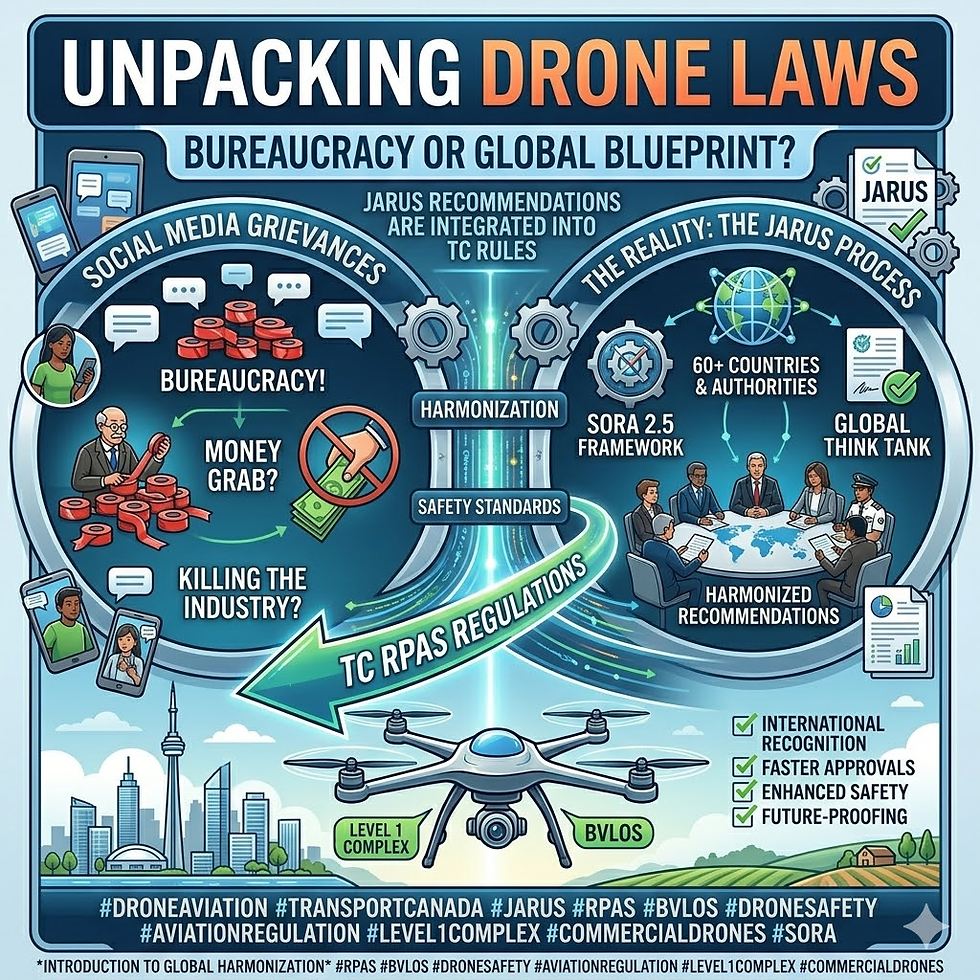
It’s a common sight on drone forums and social media groups: a new Transport Canada (TC) update drops, and the comments section immediately catches fire. Phrases like "bureaucratic overreach," "money grab," and "killing the industry" dominate the feed.
To the solo pilot or small business owner, it can certainly feel that way. You just want to fly, but instead, you're hit with new exam requirements, Level 1 Complex (L1C) declarations, and updated Standard 922 safety assurances.
But if we peel back the curtain, these rules aren't being dreamed up by a bored clerk in Ottawa. They are part of a global blueprint called JARUS. Understanding who JARUS is—and why they exist—changes the entire conversation from "Why is TC doing this to us?" to "How do we get Canada ready for the global drone economy?"
Meeting JARUS: The Architect Behind the Curtain
If you want to understand the "why" behind the "what," you have to look at JARUS (Joint Authorities for Rulemaking on Unmanned Systems).
JARUS is a global "super-group" of aviation experts from over 60 countries—including Transport Canada. Their job is to solve the biggest headache in modern aviation: How do we let millions of robots share the sky with 300-seat passenger jets?
When you see a new regulation in Canada, you aren't looking at a "money grab." You are looking at a JARUS Recommendation being put into practice.
Is it Bureaucracy? Or is it Harmonization?
Imagine if every province in Canada had different shaped electrical outlets. You’d have to buy a new charger every time you crossed the border. That is what drone aviation looks like without JARUS.
If Transport Canada didn’t follow JARUS recommendations, a Canadian drone pilot would never be able to fly a mission in the US or Europe without starting their certification from scratch. By adopting JARUS standards (like the SORA framework), TC is ensuring that a "Professional Pilot" in Canada is recognized globally.
Fact-Check: Is the "Complex" Category Just Red Tape?
One of the biggest social media gripes is the move toward Level 1 Complex (L1C) operations. It feels like extra paperwork for the sake of paperwork.
The Reality: This is the direct application of the JARUS SORA (Specific Operations Risk Assessment).
Before JARUS, if you wanted to fly a complex mission (like BVLOS), you had to wait weeks for a human at TC to manually review your flight plan. It was slow and inconsistent. The new "Complex" framework moves the industry toward Safety Assurance.
The JARUS Play: By standardizing "how safe is safe," JARUS allows TC to automate approvals for low-to-medium risk missions, actually reducing bureaucracy in the long run.
The "Money Grab" Myth
"Why do I need a new certificate?" "Why do I need to pay for a specialized flight school for L1C?"
The "money grab" argument falls apart when you look at the cost of failure. JARUS recommendations focus on proportionality. They suggest that a kid flying a 249g drone in a park shouldn't face the same hurdles as an enterprise pilot flying a 25kg drone over a suburban neighborhood.
If you are doing high-level commercial work, the "barrier to entry" (like RPOC manuals and SOPs) exists to protect you from liability. When TC updates the Aeronautical Information Manual (AIM), they are giving you a legal right to the sky alongside Air Canada and WestJet.
The Big Picture: Why JARUS Matters to You
The next time you see a "hot take" on social media about the "death of the industry," remember this: Isolation is the real industry killer.
If Canada ignored JARUS and stayed "simple," we would be stuck flying small drones in empty fields forever. We would never get routine cargo delivery, wide-scale infrastructure inspection, or advanced emergency response.
JARUS provides the roadmap; Transport Canada provides the license.
By aligning with international standards, TC is actually future-proofing your career. They are ensuring that when you invest in a "Level 1 Complex" program, that investment carries weight in the global aviation market of tomorrow.
References & Further Reading:
JARUS Official Site: jarus-rpas.org – Review the SORA 2.5 framework and international mission goals.
Transport Canada Drone Zone (Issue 6, April 2026): Updates on L1C and Standard 922 Safety Assurances.
TC AIM (March 2026 Edition): New sections on RPA 3.4 (Advanced and Complex Operations).
ICAO Unmanned Aviation: Global standards for registration and tracking.

Comments