


The Mental Cockpit: How "Chair Flying" Like the Blue Angels Can Revolutionize Drone Safety - Visualization
By: Colonel (ret) Bernie Derbach, KR Droneworks, 23 Jan 26
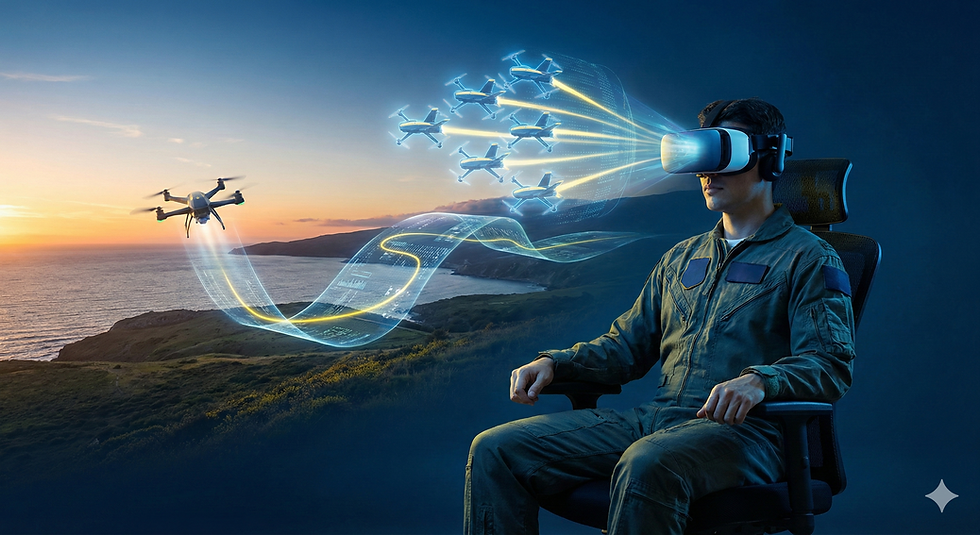
If you have ever watched the US Navy Blue Angels perform, you know it is a symphony of precision. Six F/A-18 Super Hornets roaring inches apart, executing maneuvers that seem to defy physics. But the most critical part of their performance doesn't happen in the sky. It happens in a quiet briefing room, hours before takeoff.
In a ritual known as "chair flying," the pilots sit around a table, eyes closed, hands moving in the air. They are mentally flying the entire show. The Flight Leader calls out the radio commands—“Up... a distinct pull... easing power...”—and every pilot visualizes their specific inputs in perfect synchronization. They aren't just thinking about the flight; they are living it neurologically before the engines even start.
For the drone industry, often focused on hardware specs and software updates, this human element is the missing link. Applying this level of visualization—specifically mental rehearsal and cognitive modeling—to Unmanned Aerial Systems (UAS) operations is not just a fancy trick; it is a proven methodology to enhance mission success and, more importantly, flight safety.
The Science of the "Mind’s Eye"
To understand why this works for a drone pilot standing on the ground, we have to look at the brain. Research in sports psychology and aviation human factors has long established that the brain has difficulty distinguishing between a vividly imagined event and a real one. When you visualize a flight path, your brain stimulates the same neural pathways as it does when you are actually moving the control sticks.
This process builds muscle memory without the risk. For a drone pilot, who must often translate a 3D aircraft position into 2D stick movements (especially when flying nose-in), this mental bridge is vital. By "flying" the mission in your head, you reduce cognitive load—the amount of mental effort used in working memory. When the real flight happens, your brain recognizes the pattern. You aren't reacting; you are executing a memory.
Applying "Chair Flying" to Drone Operations
How do we take a technique designed for fighter jets and apply it to a commercial drone inspection, cinematography mission, or search and rescue operation? It requires shifting from a passive "pre-flight check" to an active "pre-flight rehearsal."
1. The Solo Rehearsal: Beyond the Checklist
Most drone pilots rely on a written checklist to ensure the battery is charged and the props are tight. Visualization goes a step further. It asks you to simulate the mission flow.
The Drill: Sit in a quiet space (or even your vehicle) before the flight. Close your eyes.
Visualize the Terrain: Picture the site map you studied. Where are the power lines? Where is the tree line?
Fly the Stick Inputs: Physically move your thumbs on the controller while the drone is still powered off. If you are planning a cinematic reveal maneuver, practice the complex combination of yaw, pitch, and gimbal tilt.
Visualize the Emergency: This is critical. Don't just plan for success; visualize the failure. Imagine the video feed cutting out. What is your immediate physical reaction? Do you toggle to ATTI mode? Do you look up to spot the aircraft? By rehearsing the panic, you inoculate yourself against it.
2. The Team Sync: Shared Mental Models
The Blue Angels don't just visualize alone; they visualize together. In professional drone operations involving a Pilot in Command (PIC) and a Visual Observer (VO), this is part of Crew Resource Management (CRM).
A major cause of drone accidents is a breakdown in communication—the pilot thinks the observer sees the obstacle, but the observer assumes the pilot sees it. Visualization creates a Shared Mental Model.
The Drill: Before the motors spin, the PIC and VO should stand together and talk through the flight in real-time.
PIC: "I am going to push out 200 feet towards that cell tower."
VO: "I will track you from the 3 o'clock position. If I see a bird, I will call 'BIRD, PAUSE'."
PIC: "If you call 'PAUSE', I will immediately release right stick and hover."
This verbal and mental walkthrough ensures that when a hazard appears, the team doesn't have to negotiate a response; they have already agreed on it.
Visualization as a Safety Tool
The Federal Aviation Administration (FAA) and various aviation safety bodies emphasize that safety is not just about rules; it is about "Airmanship." A key component of airmanship is Situational Awareness (SA).
Visualization builds a reservoir of SA. When a pilot "chair flies" a mission, they are essentially pre-loading their brain with the expected state of the flight. This makes it much easier to spot a deviation.
Scenario: You are inspecting a bridge. In your visualization, you anticipated that the wind coming around the pillar would push the drone left.
Reality: As you fly, the drone drifts left. Because you visualized this, you don't freeze. You instinctively correct it because you "saw" it happen in your mind ten minutes ago.
This concept ties directly to the OODA Loop (Observe, Orient, Decide, Act). Visualization speeds up the "Orient" and "Decide" phases, allowing the pilot to "Act" faster than a pilot who is figuring it out on the fly.
Conclusion: Professionalism is a Mindset
The Blue Angels do not chair fly because they are bad pilots who need the practice; they do it because they are the best pilots who refuse to leave anything to chance.
For the drone industry to mature—especially as we move toward complex operations like Beyond Visual Line of Sight (BVLOS) and heavy-lift deliveries—pilots must adopt professional aviation habits. We must move beyond simply being "operators" who react to a screen, and become "aviators" who are ahead of the aircraft.
Next time you head out to the field, before you arm the motors, take two minutes. Sit down. Close your eyes. Fly the mission. Your brain, your client, and your aircraft will thank you.
References
Blue Angels Chair Flying Ritual
Source: "Watch The Meditative-Like Ritual The Blue Angels Go Through Before Every Flight Demo." The War Zone, 2021.
Context: Details the precise "mental choreography" used by the flight leader and team to rehearse radio calls and stick movements.
Crew Resource Management (CRM) in Drone Ops
Source: "Crew Resource Management (CRM) | SKYbrary Aviation Safety."
Context: Defines CRM as the effective use of all resources (including human cognition) to ensure safety, highlighting the importance of "Shared Mental Models."
Cognitive Performance and Drone Safety
Source: "Cognitive Performance and Decision-Making in Drone Operations." HSToday, 2025.
Context: Discusses the OODA loop and how cognitive overload can lead to mission errors, supporting the argument for mental rehearsal to reduce load.
FAA & General Aviation "Chair Flying"
Source: "The Many Benefits of Chair Flying." PlaneEnglish, 2022.
Context: Explains the general aviation application of chair flying for building muscle memory and mastering procedures without the cost of flight time.
Visual Observer Coordination
Source: "Training Your Visual Observer (VO)." Drone Pilot Ground School.
Context: outlines the specific scanning and communication responsibilities of a VO, which serves as the foundation for team-based visualization drills.

Comments