


So You Want to Fly for a Living? The Real Truth About Drone Pilot Careers in Canada
By: Colonel (ret) Bernie Derbach, KR Droneworks, 19 Dec 2025

If you have ever looked up at a drone buzzing overhead and thought, "Can I actually make a living doing that?" you are not alone. For a long time, the answer was a hesitant "maybe," reserved for a few niche photographers.
But in 2025? The answer is a resounding YES.
The Canadian drone industry has matured from a "cool gadget" phase into a critical industrial tool. You are not just destined to film weddings (unless you want to); you are destined to become an aerial data specialist, a remote inspector, or even a precision agriculturist.
Here is the no-nonsense breakdown of the Canadian drone career landscape, the training you really need, who is hiring, and whether you should get a job or build your own empire.
The Money: What Can You Actually Earn?
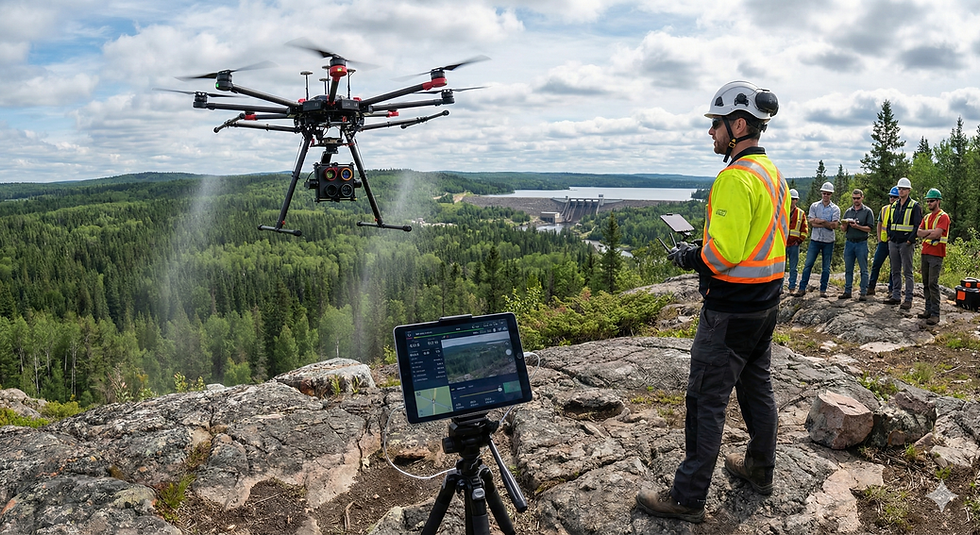
Let’s get the big question out of the way. Can you pay the bills? The good news is that as the industry specializes, salaries are climbing.
Entry-Level / Junior Pilot: $50,000 - $65,000 CAD per year. Typical work: Visual line-of-sight flights, basic photography, simple roof inspections, and data processing support.
Experienced / Specialized Pilot: $75,000 - $100,000+ CAD per year. Typical work: Beyond Visual Line of Sight (BVLOS) operations, complex LiDAR mapping, thermal inspections for energy companies, or flying heavy-lift agricultural drones. The six-figure jobs are for pilots with deep technical expertise in a specific niche.
Contract / Freelance Rates: $60 - $200+ per hour. Reality Check: While the hourly rate looks high, remember this covers your equipment wear-and-tear, commercial insurance, travel, and unbillable hours spent planning and processing data.
Sectors & Use Cases: Where the Real Work Is
Canada’s vast geography and resource-based economy make it the perfect playground for industrial drones. Forget just taking pretty pictures; here is where the real work is happening.
1. Agriculture & Forestry (The Heavy Lifters) What they do: This is precision farming at its finest. Pilots use drones for targeted spraying of fungicides and fertilizers, seeding forests in hard-to-reach areas for reforestation, and using multispectral cameras to scan crop health before the naked eye can see disease. Drones used: Heavy-lift platforms like the DJI Agras T40 or T50 (massive drones that can carry 40kg+ of liquid payload). The Job: You aren't just a pilot; you are an integral part of the farm management team, analyzing data to help farmers increase yields and reduce chemical use.

Image: A large agricultural drone spraying a field]
2. Infrastructure & Utilities (The Ice Breakers) What they do: Inspecting thousands of kilometers of hydro lines for damage, checking wind turbine blades for stress cracks with thermal cameras, and yes—clearing ice. Utilities like Hydro-Québec have piloted programs using drones with de-icing payloads to knock ice off lines, a task that prevents massive outages and is far safer than sending a human in a helicopter. Drones used: Enterprise workhorses like the DJI Matrice 300/350 RTK with high-resolution thermal cameras (like the Zenmuse H20T) or custom-built heavy-lift rigs for de-icing operations.

Image: A drone inspecting a high voltage power line
3. Engineering, Surveying & Mining (The Data Wizards) What they do: Creating centimeter-accurate "Digital Twins" of construction sites to track progress, measuring stockpile volumes in mines (so humans don't have to climb dangerous piles of gravel), and conducting large-scale LiDAR mapping for new road and pipeline planning. The Job: This is highly technical. You need to understand RTK (Real-Time Kinematic) GPS accuracy, photogrammetry software, and data processing. It’s less about the "joy of flying" and more about the "joy of capturing perfect data."

Image: A drone assisting with a mining operation
4. Building & Industrial Cleaning (The New Frontier) What they do: A rapidly growing niche. Pilots use tethered drones connected to a ground water source to spray high-pressure cleaning fluid on skyscrapers, stadium roofs, and vast solar panel farms. It is drastically faster and safer than traditional rope access or scaffolding methods. Drones used: Custom heavy-duty tethered drone systems designed for continuous operation and high-pressure spraying.

Image: A drone conducting window washing
The Missing Link: Why You NEED Professional Training

Image: A student pilot holding a controller while an instructor points at a drone screen
Passing the Transport Canada online Basic or Advanced exam is just the beginning—it's the equivalent of getting your learner's permit. To land the high-paying jobs and safely operate $30,000+ equipment, you need professional, in-person flight training.
Serious employers and clients want proof that you can handle complex, real-world scenarios, not just answer multiple-choice questions.
Hands-on Experience: You need to log flight hours on enterprise-grade drones (like the DJI Matrice series), not just a consumer Mavic.
Complex Operations: Learn how to plan and execute missions in controlled airspace, near critical infrastructure, and in challenging weather conditions.
BVLOS (Beyond Visual Line of Sight): This is the future of commercial droning. Training for BVLOS operations opens up massive opportunities for long-range inspections (pipelines, power lines, railways) that are impossible with standard visual line-of-sight rules.
Look for reputable training organizations like Veterans Elite Drone Training Services, Seneca Polytechnic, KR Droneworks or other Transport Canada-compliant schools that offer practical flight reviews and specialized courses for industrial applications. This investment is your gateway to a serious career.
How to Pay for It: Funding Your Flight Path

Image: Display of possible Course Funding Sources
Professional training is an investment, but the good news is that you rarely have to pay for it entirely out of pocket. Whether you are a veteran, a laid-off worker, or an employee looking to upskill, there are specific funding buckets available in 2025.
1. For Veterans & Military Members
If you served in the Canadian Armed Forces, the government has robust pathways to help you transition into this high-demand trade.
Veterans Affairs Canada (VAC) Education and Training Benefit: This is the primary route for honorably released members. Depending on your length of service (6 or 12 years), you may be eligible for $40,000 to $80,000 in taxable funding to cover tuition, books, and living expenses during training.
Manulife SISIP Vocational Rehabilitation: This is specific to CAF members who were medically released. SISIP (Service Income Security Insurance Plan) focuses on "Vocational Rehabilitation" to get you back into the workforce. If drone piloting aligns with your medical limitations and aptitudes, this program can cover 100% of training costs, including supplies and internet allowances, to retrain you for a new civilian career.
2. For Civilians & Job Seekers
You don't need a military background to get financial help. Federal and Provincial governments are aggressively funding tech training.
Canada Job Grant (CJG): This is an employer-driven grant available in most provinces (e.g., Canada-Ontario Job Grant, Canada-Alberta Job Grant).
How it works: You must have a job offer or be currently employed. The employer applies for the grant to train you. The government typically covers two-thirds of the training cost (up to $10,000), and the employer pays the remaining third. This is a great negotiating tool: "If you hire me, the government will pay for most of my advanced drone certification."
Better Jobs Ontario (Formerly Second Career): If you have been laid off and are currently unemployed, this program can provide up to $28,000 for tuition, books, and living allowances for training programs less than 52 weeks long—perfect for intensive drone pilot courses.
WorkBC Future Skills Grant: For residents of British Columbia, this grant offers up to $3,500 specifically for short-term skills training, which can cover a significant portion of a flight review or specialized ground school.
3. Indigenous Skills Training
ISETP (Indigenous Skills and Employment Training Program): Indigenous candidates can access funding through local service delivery organizations. These organizations have the flexibility to fund skills training that leads to sustainable employment, making the growing drone sector a prime candidate for approval.
Who is Hiring? (Real Companies & Contacts)
You are not destined to be a solo-preneur if you don't want to be. There are established Canadian companies actively hiring pilots and drone technicians.
1. Stinson Aerial Services The Scoop: A major player in wildfire management. They contract with provincial governments to use drones for thermal hotspot detection on forest fires. If you want a high-impact, adventurous role, this is it. Contact/Careers: Stinson Aerial Careers (Look for "Advanced RPAS Pilot" roles).
2. AltoMaxx The Scoop: Headquartered in St. John's, NL, but operating globally. They specialize in some of the most technically demanding inspections, including indoor confined spaces (like storage tanks and boilers) using specialized collision-tolerant drones. Contact/Careers: AltoMaxx Careers (Email: hr@altomaxx.com).
3. Drone Sky Cleaners The Scoop: A company focused entirely on the cleaning niche, using drones to clean windows and facades on high-rise buildings. Contact: Drone Sky Cleaners (Use their contact form for pilot inquiries).
4. IRIS PDM (Precision Data Management) The Scoop: Experts in the renewable energy sector. They hire pilots to conduct detailed thermal and visual inspections of solar farms and wind turbines to detect faults and inefficiencies. Contact: IRIS PDM (Check their "About" or "Contact" sections).
5. FlyGuys The Scoop: Think of this as the "Uber" for drone pilots. It's a platform that connects pilots with freelance jobs across various industries. It's a good way to build experience and pick up contract work if you have your own gear. Contact: FlyGuys Pilot Network
The Million Dollar Question: Get a Job or Start a Company?
This is the biggest decision you'll make. There is no right answer, only the right answer for you.
Option A: The Employee (The Smart Start) Pros: You fly their $50,000 drone. If it crashes (and you followed protocol), it’s their insurance claim, not your financial disaster. You get a steady paycheck, benefits, and mentors to learn from. You gain experience on a variety of projects without having to do any sales. Cons: You have less autonomy. You fly where and when they tell you, and your earning potential is capped by your salary. Best For: Most new pilots. It’s the safest and most effective way to build your skills, flight hours, and industry network.
Option B: The Owner/Operator (The Long Game) Pros: You keep 100% of the profits. You choose your clients, set your own schedule, and can specialize in a niche you're passionate about. The long-term earning potential is higher if you scale successfully.
Cons:
The Cost: A professional survey drone setup can easily cost $15,000 - $40,000+. Commercial liability insurance (typically $5M coverage) will cost you $800 - $2,000+ per year.
The Hustle: You are not just a pilot; you are also the CEO, salesperson, accountant, and marketing manager. You will spend 80% of your time running a business and only 20% flying. Best For: Experienced pilots with a strong business acumen, an existing network of potential clients, and the financial cushion to survive the lean startup phase.
Final Verdict: The dream of a drone career in Canada is real, but it's not a "get-rich-quick" scheme. It's a skilled trade. Get your Advanced or Level 1 Complex certification, invest in professional hands-on training, and get hired by an established company to learn the ropes. Once you are an expert with a solid network, you can decide if launching your own enterprise is the right next step.

Comments