


SMS for Drone Operations: A Blueprint for Professional RPAS Excellence - An Update
By: Colonel (ret) Bernie Derbach, KR Droneworks, 03 Feb 2026

Inspired by the original insights from Aviation-knowledge, this expanded guide adapts high-level airline Safety Management Systems (SMS) into a practical operational framework for the Canadian Remotely Piloted Aircraft System (RPAS) sector.
Whether you are a solo freelancer or managing a corporate fleet, safety is your primary professional currency.
In the rapidly maturing Canadian drone industry, the distinction between a "hobbyist" and a "professional operator" is defined by a single framework: the Safety Management System (SMS). As of late 2025, Transport Canada has significantly expanded privileges for Advanced and Level 1 Complex pilots, allowing for lower-risk Beyond Visual Line of Sight (BVLOS) operations under CARs Part IX. With these expanded privileges comes a regulatory and ethical responsibility to manage risk systematically.
1. Hazard Identification: Detecting the "Weak Signals"
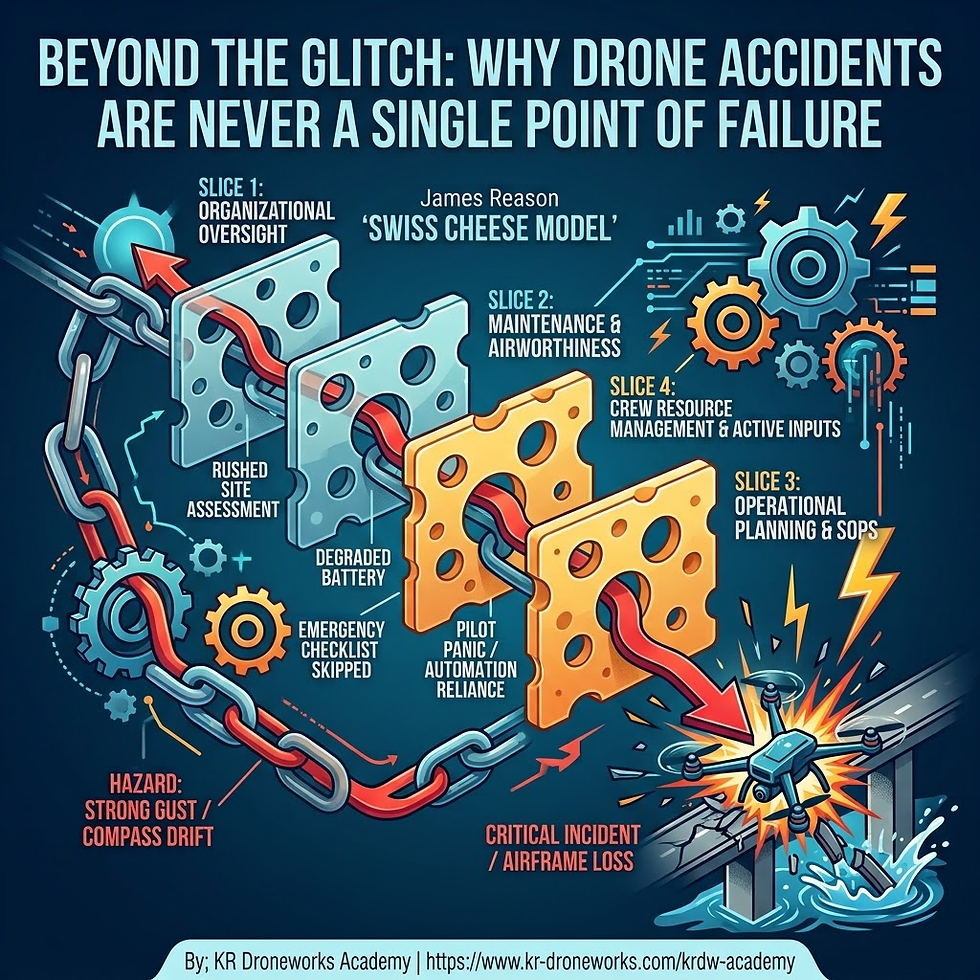
In a professional drone environment, hazards are rarely as obvious as a bird strike. They often appear as "weak signals" that, if ignored, lead to catastrophic failure.
Technical Hazards: Lithium-polymer (LiPo) battery swelling, degrading Command & Control (C2) link signals in high-EMI (Electromagnetic Interference) urban environments, or latent software bugs after a firmware update.
Environmental Hazards: "Micro-climates" around tall buildings, the K-index affecting GNSS accuracy, or unforecasted low-level mechanical turbulence.
Organizational Hazards: Pressure to fly in marginal weather to meet client deadlines or a lack of standardized training for new crew members.
Professional operators use multiple inputs—Occurrence Reports, flight logs, and maintenance audits—to capture these signals before they reach the flight line.
2. Risk Assessment: The Logic of Safety
The core of your SMS is the Risk Matrix, which transforms subjective "gut feelings" into data-driven decisions.

How to Use the Risk Matrix
When a hazard is identified, it must be plotted against two axes:
Severity: If this RPA falls, what is the "credible worst outcome"? (e.g., Catastrophic/A for mid-air collisions vs. Negligible/E for minor prop nicks).
Probability: Based on fleet history and manufacturer data, how often is this likely to occur? (e.g., Frequent/5 vs. Extremely Improbable/1).
The "Red" Zone (Unacceptable): Operations must not proceed. The risk is too high for the safety of the public or airspace.
The "Yellow" Zone (Tolerable): Risks may be accepted only if they are mitigated to a level that is As Low As Reasonably Practicable (ALARP).
Targeting the "Green" (Acceptable): This is where professional operations reside. Mitigations such as changing flight paths, using a Visual Observer (VO), or installing a parachute system shift the risk from the red/yellow toward the green.
3. The Regulatory Ladder: CARs Part IX and Beyond
Transport Canada’s framework is designed to scale with your operational complexity.
Pilot Certificate – Level 1 Complex
Introduced for lower-risk BVLOS and medium drone operations, this certification is the new benchmark for professional pilots.
Requirements: Applicants must be 18 years old, hold an Advanced Certificate, complete 20 hours of ground school, and pass the Level 1 Complex Exam and a flight review.
Knowledge Areas: Focuses on EMI sources (including the K-index), urban airflow, human factors, and advanced emergency procedures (covered in TP 15530).
RPAS Operator Certificate (RPOC)
To conduct Level 1 Complex operations, an organization must hold an RPOC. This is your "license to operate" as a business, requiring:
An Accountable Executive responsible for overall safety.
A Person Responsible for Maintenance (PRM) to ensure airworthiness.
Documented Standard Operating Procedures (SOPs) and a Maintenance Control Manual (MCM).
Special Flight Operations Certificates (SFOC)
For missions exceeding standard rules (e.g., drones over 150kg or flying above 400ft AGL in uncontrolled airspace), an SFOC is required. This typically involves a Specific Operational Risk Assessment (SORA) as per AC 903-001.
4. Integration: The Risk Management Plan (RMP) in the MCM
A professional Maintenance Control Manual (MCM) is more than just a repair log; it is a critical safety control.
Drafting the RMP for your Manuals
Your RMP should be a dedicated section within your RPOC suite that outlines how you:
Identify Hazards: Through daily pre-flight inspections and post-flight debriefs.
Analyze Risk: Using the 5x5 Matrix to evaluate technical defects.
Implement Controls: Establishing a Critical Parts List (CPL)—components like flight controllers or motors whose failure results in a "Catastrophic" rating.
Monitor Performance: Tracking "mean time between failures" to adjust maintenance intervals in the MCM.
MCM Integration Tip: Link your risk levels to maintenance actions. A "Hazardous" technical trend (e.g., multiple reports of motor bearing wear) should trigger an immediate fleet-wide "Mandatory Action" or inspection before the next flight.
5. SOPs and Checklists: The Pilot's Shield
In a mature SMS, SOPs and Checklists are not suggestions; they are mitigations.
SOPs: Define how you operate, ensuring that every pilot handles emergencies like "Lost Link" or "Fly-away" identically.
Checklists: These are "memory joggers" (e.g., using an "Air Force Style" challenge-response) that prevent human fatigue or distraction from leading to a missed safety step.
6. Closing the Loop: Just Culture
The most sophisticated SMS will fail without a Just Culture. Pilots must feel safe to report their own errors—such as a near-miss or a "hard landing"—without fear of retribution. Safety intelligence grows when data is used for learning, not blame.
Essential Resource Links
CARs Part IX Full Text: The legal foundation for all Canadian drone flight.
TP 15530: Level 1 Complex Knowledge Requirements: The study guide for advanced pilots.
AC 901-002: Guidance on RPOC Manual Development: Essential for drafting your OM and MCM.
AC 903-001: SORA and Risk Assessment: The "Gold Standard" for operational risk assessment.
References
Hashim, A. M., et al. (2024). UAV avionics safety, certification, and reliability. Drone Systems and Applications, 12.
Transport Canada. (2025). Summary of changes to Canada's drone regulations. Civil Aviation Department.
van der Sluijs, J., et al. (2023). BVLOS drone operations for environmental monitoring in Canada. Drone Systems and Applications, 11.

Comments