


Planning a Drone Trip to Europe? Why You Need to Know About the "EU Declaration of Conformity"
By: Colonel (ret) Bernie Derbach, KR Droneworks, 17 Dec 25

If you are a Canadian RPAS (Remotely Piloted Aircraft System) pilot planning to travel to Europe with your drone, you are likely aware that the rules are different across the Atlantic. However, one specific document—and a tiny label on your drone—has become the golden ticket for flying legally and freely in the EU: the EU Declaration of Conformity (DoC).
Here is what this information is, why it is critical for your trip, and where to find it.
What is the EU Declaration of Conformity?
The EU Declaration of Conformity is an official document from the manufacturer (like DJI) certifying that a specific product meets all relevant European Union safety, health, and environmental requirements.
For drone pilots, this document is the formal proof that your drone complies with the EASA (European Union Aviation Safety Agency) regulations and has been assigned a specific Class Identification Label (such as C0, C1, C2, C3, or C4). Link to the Official DJI Euro Compliance Site: https://www.dji.com/ca/euro-compliance

Image 2: A close-up of the official EU Declaration of Conformity document.
Why is this Important for Canadian Pilots?
As a non-EU resident, you cannot simply unpack your drone and fly under Canadian rules. The EU has a unified set of drone regulations that apply to all EASA member states (including popular destinations like France, Germany, Italy, Spain, and even non-EU members like Switzerland and Norway).
Here is why the DoC and Class Identification are vital for your travels:
1. It Determines Where You Can Fly (The "Open" Category) European rules are risk-based. Your drone’s Class (C0–C4) dictates which "subcategory" you can fly in:
C0 & C1 (Low Risk): Allows you to fly in the A1 subcategory, which permits flying over scattered people (but not crowds). This is essential for capturing travel content in most areas.
Legacy Drones (No Class Label): If your drone does not have a Class label (or a DoC proving compliance), you are generally relegated to the A3 subcategory. This requires you to stay at least 150 meters away from residential, commercial, industrial, or recreational areas. Practically, this bans you from flying near almost any city, town, or landmark you’d want to visit.
2. Proof of Compliance for Officials If you are stopped by local authorities, having a copy of the Declaration of Conformity (digital or printed) acts as proof that your equipment is legal for use in the Open Category. It validates the Class label sticker on your drone.
3. Simplifies Registration As a Canadian, you must register as a drone operator in the first EASA country you intend to operate in. You will receive a unique Operator ID that you must attach to your drone. You do not need to register in every country—that single ID is valid across all EASA states. Knowing your drone’s class simplifies this registration process and ensures you are taking the correct online training (e.g., A1/A3 proof of competency).
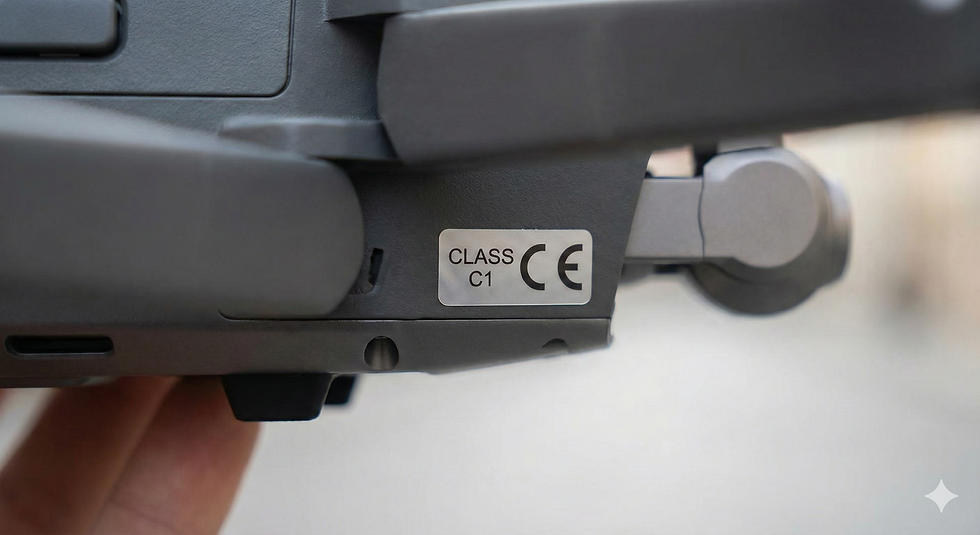
Image 3: A close-up of the "Class C1" CE label on the drone's body.
What You Should Do Before You Travel
Check Your Label: Look for the class identification label (e.g., "C1") on your drone's body.
Download the DoC: Visit the DJI Euro Compliance site, find your specific drone model, and download the "EU Declaration of Conformity." Save it to your phone or print a copy for your flight bag.
Register Once: Register as an operator in your first destination country (e.g., if you land in Paris, register with the French DGAC).
Mark Your Drone: Apply your Operator ID to your drone and ensure the Class label is visible.
Safe travels and happy flying!

Comments